
Founded in 2009, ZenGRC offers robust, intuitive products that help organizations graduate from manual processes and point solutions, turning compliance and risk management into a source of business advantage. We help organizations better navigate the complexities of governance, risk, and compliance.
Organizations invest heavily in compliance, check every box, satisfy every auditor, and still find themselves exposed when something goes wrong. The reason, more often than not, isn’t a lack of compliance. It’s a lack of governance.
Understanding the difference between governance vs. compliance — and why neither works without the other — is one of the most important distinctions any business or IT leader can make. Let’s dive into why:
What Is Compliance in Business?
Compliance means meeting a defined set of external requirements. These requirements come from regulators, industry bodies, and contractual obligations: HIPAA for healthcare, PCI DSS for payment data, SOC 2 for SaaS providers, GDPR for anyone handling EU citizen data.
Compliance is, by nature, reactive. A regulation exists. You demonstrate that you meet its requirements. An auditor validates that you do. Done — until the next audit cycle, the next regulation, or the next change in your environment.

This isn’t a knock on compliance. Meeting regulatory requirements is non-negotiable. Violations carry real consequences: fines, enforcement actions, lost contracts, and reputational damage. But compliance answers a specific question: Are we meeting the requirements as written?
It does not answer: Are we actually secure? Are we making the right decisions? Are we prepared for what comes next?
What Is Governance in Business?
Governance is the internal system your organization uses to make decisions, assign accountability, and ensure that policies are followed — not because a regulator requires it, but because it’s how responsible organizations operate.
Where compliance is externally defined, governance is internally driven. It establishes who owns which risks, how decisions get escalated, what your risk appetite looks like, and whether the controls you implement actually reflect your organization’s values and strategic objectives.
Governance asks the questions compliance doesn’t: Who is accountable when something goes wrong? Are our policies keeping pace with how the business is actually operating? Are we building security into decisions before problems arise — or patching gaps after?

Strong governance is what turns a compliance program from a periodic exercise into an ongoing operational capability.
The Difference Between Governance vs. Compliance
What is the difference between governance vs. compliance? While governance and compliance are deeply connected, they operate differently across several dimensions:
Driven by: Compliance is externally mandated. Governance is internally designed.
Timing: Compliance tends to be periodic — tied to audit cycles and certification renewals. Governance is continuous — it informs decisions every day.
Ownership: Compliance is often owned by legal, privacy, or security teams. Governance requires participation from leadership, the board, and business unit owners.
Goal: Compliance demonstrates adherence to a standard. Governance builds the culture, structure, and accountability that makes adherence sustainable.
Measurement: Compliance is binary — you pass or you don’t. Governance is a maturity question — how consistently, how deeply, and how proactively are policies embedded in how the organization operates?
The critical insight here is that you can be fully compliant and still have weak governance. And organizations with weak governance are one regulation change, one new vendor, or one audit scope expansion away from a serious problem.
Why You Can’t Have One Without the Other
Compliance without governance is fragile. You build controls to satisfy a framework. You gather evidence before the audit. You pass. But because no one owns the ongoing effectiveness of those controls — because there’s no governance structure ensuring they stay current as the business evolves — they quietly degrade between audit cycles. When the next assessment arrives, or when a real incident occurs, the gaps surface.

Governance without compliance is equally risky. You can have robust internal policies, strong board oversight, and a clear risk appetite — and still face regulatory penalties if your controls don’t map to the specific requirements of HIPAA, SOC 2, or whichever frameworks apply to your business.
The organizations that manage risk most effectively treat governance and compliance as two sides of the same system. Governance provides the structure that makes compliance sustainable. Compliance provides the external validation that governance is working.
This is why modern GRC — Governance, Risk, and Compliance — treats all three as an integrated program rather than separate workstreams. Risk sits in the middle, connecting the internal accountability structures of governance to the external requirements of compliance.
What This Means for Business and IT Leaders
If you’re evaluating whether your organization needs a more structured approach to GRC, the governance vs. compliance distinction is a useful diagnostic.
Ask yourself:
- Do we know who owns each of our compliance requirements — not just during audit season, but every day?
- When a new regulation emerges, do we have a process for assessing its impact, or do we scramble to respond?
- Are our controls continuously monitored for effectiveness, or do we find out they’ve failed during an audit?
- Can leadership see our current risk and compliance posture in real time, or only through quarterly reports?
If the honest answer to most of these is “no” or “not really,” your organization may have compliance activity but insufficient governance. That gap is exactly where risk lives.
How a Unified GRC Platform Bridges the Gap
Managing governance and compliance as separate functions — different teams, different tools, different timelines — creates the fragmentation that makes both less effective. Evidence collected for one framework doesn’t flow to another. Policies approved in one system aren’t visible to the team tracking controls in a spreadsheet elsewhere. Leadership lacks a consolidated view of where the organization actually stands. It shouldn’t be viewed as governance vs. compliance. It should be viewed as governance AND compliance.
A purpose-built GRC platform solves this by unifying governance and compliance into a single operational environment. Controls map across frameworks, eliminating redundant work. Risk scores update continuously as evidence is collected and controls are tested. Workflows enforce accountability at every step. Dashboards give leadership real-time visibility rather than periodic snapshots.
The result isn’t just better compliance. It’s a governance structure that makes compliance sustainable — and a compliance program that demonstrates your governance is working.
Where ZenGRC Comes In
ZenGRC is built for exactly this challenge. Our platform brings governance, risk, and compliance together in a unified system designed to move organizations beyond the audit-and-forget cycle toward continuous assurance.
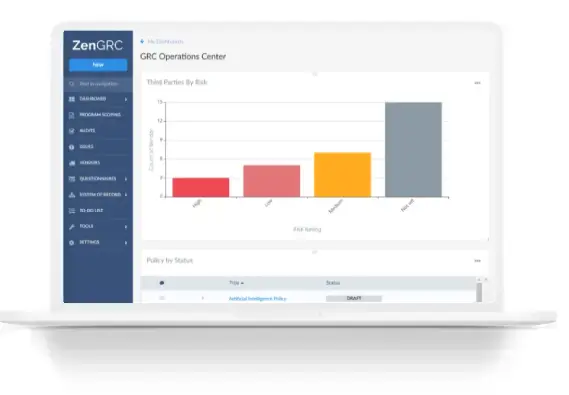
With ZenGRC, you get a pre-built library of 30+ compliance frameworks — including HIPAA, SOC 2, ISO 27001, NIST, PCI DSS, and GDPR — cross-mapped to a unified control set so your team tests once and satisfies many. Our automated compliance software provides automated evidence collection, real-time risk dashboards, and AI-powered assistance through GRACI give even lean teams the visibility and capacity to manage compliance as an ongoing operational function, not a seasonal sprint.
Governance and compliance aren’t competing priorities. They’re complementary capabilities — and when they work together in a unified platform, compliance stops being something that happens to your organization and starts being something your organization actively controls.
Ready to see what that looks like in practice? Book a demo and discover how ZenGRC helps business and IT leaders build GRC programs that are both audit-ready and strategically sound.