
Secureframe vs Vanta & ZenGRC as an Alternative
Quick Summary
For teams weighing up Secureframe vs Vanta, both cover SOC 2 well. But their per-framework pricing and limited multi-framework support pose real issues at scale. Mid-market teams managing three or more frameworks tend to find ZenGRC a better fit. It offers flat-rate unlimited pricing, direct HITRUST integration, and faster implementation than lightweight automation tools.
Struggling to Decide Between Secureframe vs Vanta?
Running SOC 2 and starting to eye ISO 27001 or HIPAA? Then Secureframe and Vanta are probably already on your shortlist.
Both platforms dominate the compliance automation space for good reason. They cut audit prep time, automate evidence collection, and get first-time certifications across the finish line. So which do you choose?
In this ZenGRC article, we’ll dive deep into how they stack up on pricing, multi-framework architecture, and real-world GRC depth, including where both start to hit their limits.
Why Secureframe and Vanta fall short for GRC
Both platforms were built for companies running one or two frameworks, not for lean mid-market teams juggling SOC 2, ISO 27001, HIPAA, HITRUST, and NIST simultaneously.
1. Pricing Models Punish Growth
The marketing promises predictable costs and fast ROI. The reality is a per-framework add-on structure that compounds quickly.
A mid-market company pursuing SOC 2, ISO 27001, and HIPAA can face $50,000 to $70,000 annually with Vanta, or $30,000 to $45,000 with Secureframe, before adding risk modules or TPRM. Annual escalations of 5-25% make multi-year budgeting a guessing game.
What starts as a reasonable line item for one certification becomes a budget shock when the board adds HIPAA or a customer demands HITRUST. Teams find themselves negotiating renewals they did not anticipate, with finance asking why compliance costs doubled year over year.
2. Multi-framework Gaps Become Painful
Neither platform is truly built for three or more concurrent frameworks.
Secureframe limits its entry plan to a single framework. Vanta’s cross-mapping exists, but reviewers note it “lacks the detailed configuration required to make it a full-fledged GRC tool.” Both built their reputations on SOC 2 automation, hence, for HITRUST, CMMC, or specialized frameworks, the depth is not there.

The practical impact hits during audit season. A team running SOC 2 and ISO 27001 simultaneously discovers that control reuse is limited, evidence must be re-collected for each framework, and the dashboard shows two separate compliance postures that do not talk to each other.
The compliance leader ends up exporting data to spreadsheets to reconcile gaps, exactly the manual workflow the platform was supposed to eliminate.
3. Customization and Flexibility Hit Ceilings
Secureframe offers limited flexibility beyond standard checklist-driven approaches. Security checks cannot be customized and automatically assign pass or fail values, which forces teams to upload manual proof even when the control does not fit the pre-built test.
Vanta’s risk management remains immature, with a pre-built risk library designed for companies new to risk assessments rather than established GRC teams. Reviewers confirm the module has “immaturities and limitations” and call the scenarios “vague.”
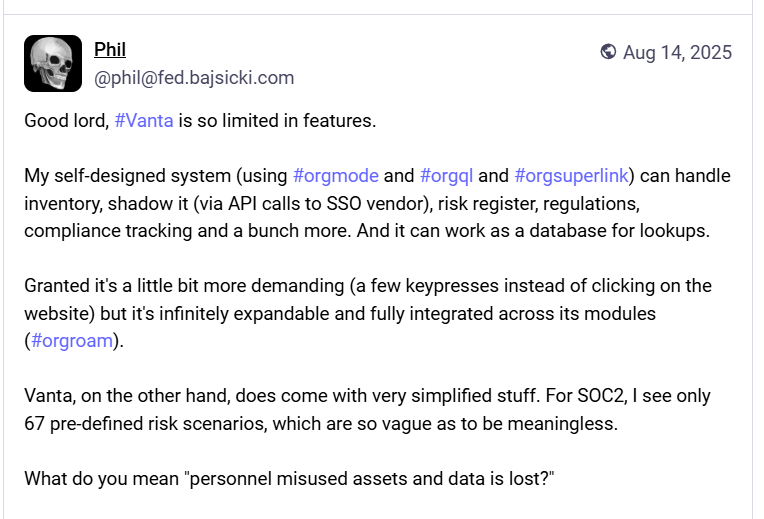
For reporting, advanced features like heat maps and trend charts sit behind higher-tier plans on both platforms. Secureframe’s Enhanced Risk Management Module is required for advanced dashboards, while Vanta’s visual reports are described as “limited” with “weak table filtering.”
4. Evidence Management Still Requires Manual Work
Despite automation claims, both platforms demand significant manual intervention for custom workflows, non-native tools, and edge-case requirements.
Vanta’s integrations do not eliminate manual work entirely. Secureframe users note that some integrations still require manual uploads, and the platform does not auto-generate key audit artifacts like system descriptions.

The gap between promised automation and actual coverage is wider than the marketing suggests. A team with a standard AWS and Okta stack sees strong automation. Add a custom internal tool, a niche vulnerability scanner, or a specialized HRIS, and the evidence collection reverts to manual exports, screenshots, and chasing.
Over time, this systematic manual work erodes the time savings that justified the platform purchase.
5. Audit Prep Becomes Firefighting Instead of Continuous Compliance
Both platforms market continuous monitoring, but the reality for mid-market teams is closer to episodic panic.
Vanta and Secureframe flag gaps in real time, yet the volume of alerts creates noise rather than clarity. Compliance teams receive notifications for failing tests across multiple frameworks, but the prioritization is shallow.
A failing access control in a dev sandbox carries the same alert weight as a gap in production PHI access. Teams spend hours triaging low-impact issues while high-risk gaps sit in the queue. The result is a reactive cycle where compliance leaders scramble to fix real problems in the weeks before an audit rather than maintaining steady-state compliance throughout the year.
6. Support Models Break Down at Scale
Vanta relies on an Ask Ilma chatbot that escalates to specialists, with support quality varying by geography and plan level. Secureframe positions itself as having more human support, but reviewers note that “dedicated depth varies by contract tier” and that limited CSM support at renewal creates gaps.
For mid-market teams running complex multi-framework programs, chatbot-first support or tier-dependent human assistance creates friction precisely when they need hands-on guidance.
Why ZenGRC is a Better Alternative for GRC
In 2024, ZenGRC became the first GRC solution to win ISACA’s Global Innovation Award for its use of agentic AI across governance, risk, and compliance.
These capabilities show how ZenGRC translates innovation into day-to-day compliance execution.
1. Direct HITRUST Integration
ZenGRC is one of only four featured HITRUST partners, with a direct MyCSF API that automates evidence submission from ZenGRC to HITRUST’s assessment platform. This eliminates the duplicate work of entering hundreds of controls and evidence items twice and cross-maps HIPAA and HITRUST controls so one artifact satisfies both frameworks.
For healthcare organizations, this integration directly addresses the 90% of HITRUST certification failures that stem from operational gaps rather than technical issues. By closing these operational gaps with automated evidence management, ZenGRC helps teams achieve stronger HITRUST outcomes without adding headcount.
The direct API connection also ensures that any changes in HITRUST requirements are automatically reflected in the platform, reducing the risk of non-compliance due to outdated controls.
2. Implementation in Weeks, Not Months
Traditional enterprise GRC tools take 6 to 12 months to deploy. ZenGRC is operational in weeks, with most teams seeing value within 60 days. For a compliance team with an audit in 90 days, that timeline is the difference between readiness and failure.
The platform’s structured onboarding process pairs every customer with a Customer Success Manager who creates a tailored implementation plan based on specific goals and priorities.

This approach eliminates the long, drawn-out configuration cycles common with legacy solutions, allowing lean compliance teams to start managing frameworks and collecting evidence almost immediately.
3. Dedicated Human Support at No Extra Cost
As mentioned previously, every ZenGRC customer receives a named Customer Success Manager for the duration of their journey. Implementation and expert support are included in all plans, not add-ons. The platform is designed for lean teams without dedicated GRC administrators.
This CSM serves as the primary relationship owner and advocate, ensuring a smooth onboarding process and ongoing success. Customers consistently highlight the value of this support model.
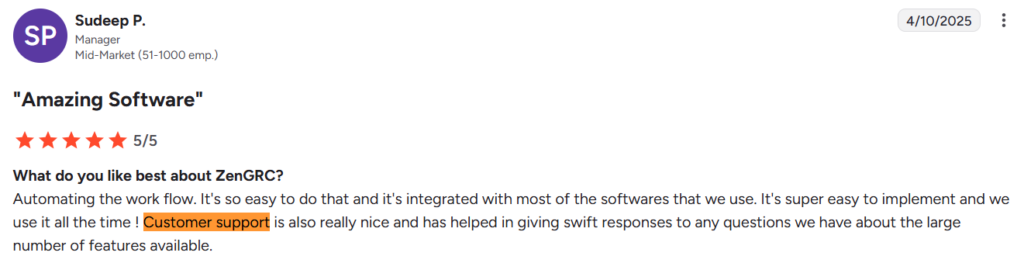
For mid-market teams running complex multi-framework programs, this level of dedicated, human-led support eliminates the friction of chatbot-first models and ensures that platform issues never become blockers to audit readiness.
4. Flat-Rate Unlimited Pricing
One price covers all frameworks, all users, and all integrations. No per-framework multipliers. No 10-15% annual escalations when adding a third or fourth framework. Teams can budget predictably for five or six years.
Unlike competitors that charge additional fees for each framework, ZenGRC’s pricing is not modular. This means a team running SOC 2, ISO 27001, HIPAA, HITRUST, NIST, and PCI DSS pays the same as a team running just SOC 2. For mid-market organizations, this predictability eliminates the budget shocks that come with adding frameworks mid-cycle.
Finance teams no longer need to re-forecast every time a customer demands a new certification or a board member requests a new risk report. The flat-rate model also includes all features, no hidden modules for risk management, vendor management, or advanced reporting that suddenly appear as line items on renewal quotes.
5. GRACI AI For Analyst-Level Compliance Work
ZenGRC’s GRACI AI is not a simple chatbot or rules-based automation tool. It is an intelligent assistant that performs analyst-level work, including new program scoping, providing advice on satisfying program objectives, designing standard or custom framework controls, and generating audit structures.
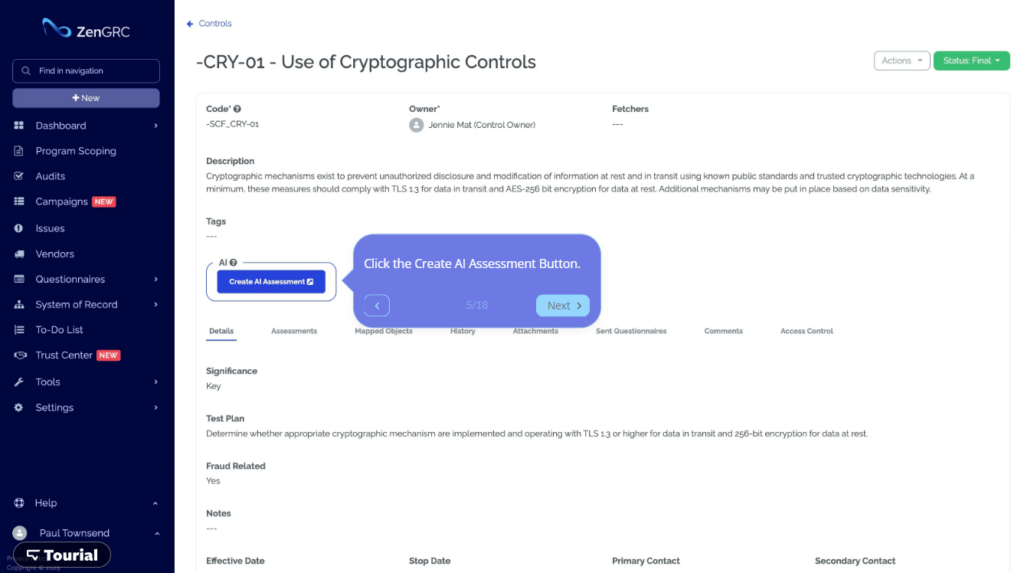
Built on AWS Bedrock, GRACI AI evaluates both the design and operating effectiveness of controls against mapped framework objectives, control wording, test plans, and additional guidance provided by the team.
This transforms hours of manual review into minutes of focused analysis while maintaining complete oversight, as every AI assessment requires explicit opt-in and can be reviewed and approved before implementation.
6. 117 Integrations for Automated Evidence Collection
ZenGRC connects directly to cloud infrastructure, identity providers, and security tools to pull evidence without manual intervention. Cross-framework evidence reuse means one artifact satisfies HITRUST, HIPAA, and SOC 2 simultaneously, eliminating redundant collection and remediation work.
The platform’s object-based approach enables seamless mapping across various compliance frameworks, providing users with a holistic view of their compliance program. This integration ecosystem means a team with a standard AWS, Okta, and Jira stack sees strong automation out of the box.
Even for custom internal tools or niche vulnerability scanners, evidence collection remains automated at source rather than reverting to manual exports, screenshots, and chasing. By centralizing all audit and compliance information in one location, ZenGRC ensures that external auditors can access the system with limited permissions, streamlining the entire audit process.
SecureFrame vs Vanta vs ZenGRC: Side-by-Side Comparison
| # | Feature | Secureframe | Vanta | ZenGRC |
| 1 | Pricing Model | Per-framework add-ons + headcount tiers | Per-framework add-ons + 5-25% annual escalations | Flat-rate unlimited; all frameworks, users, and integrations included |
| 2 | Multi-Framework Support | Best for 1-2 annual audits; common controls mapping available | 35+ frameworks with cross-mapping; growing capabilities | Built for 3+ frameworks; map once, apply everywhere via SCF foundation |
| 3 | HITRUST Integration | Not a featured partner; no direct MyCSF API | Not a featured partner; no direct MyCSF API | One of only four featured HITRUST partners; direct MyCSF API integration |
| 4 | Implementation Timeline | 2-3 weeks; requires dedicated administrator | ~60 days for SOC 2; integration issues can extend | Weeks; most teams see within 60 days; no dedicated admin required |
| 5 | AI Architecture | AI-assisted automation | Agentic AI for compliance workflows | Ephemeral isolated models per use; single-tenant |
| 6 | Evidence Management | Automated + significant manual uploads required | 300+ integrations; still maturing for complex multi-framework needs | Cross-framework evidence reuse; 117 integrations automate collection at source |
| 7 | Target Audience | Small to mid-market, first-time compliance buyers | Startups to mid-market, strong SOC 2 focus | Mid-market lean teams managing multiple frameworks concurrently |
Streamline Multi-Framework Compliance Using ZenGRC
Secureframe and Vanta both solve first-framework compliance well. But the moment your program expands to three or more frameworks, the per-framework pricing, manual workarounds, and missing GRC depth become unavoidable. Mid-market teams managing SOC 2, HIPAA, and HITRUST simultaneously need more than incremental automation.
ZenGRC was built for this moment. Flat-rate unlimited pricing covers every framework without per-seat or per-audit multipliers. A direct MyCSF API integration eliminates duplicate HITRUST work. Named Customer Success Managers and implementation included at no extra cost mean lean teams get live in weeks, not months, with no dedicated administrator required.
Book a demo to see how ZenGRC handles your full compliance program in one platform.