
Best HITRUST Compliance Software for Mid-Market Teams
Quick Summary
HITRUST compliance helps businesses prove they meet strict data protection and compliance standards. Our list of the best HITRUST compliance software features ZenGRC as the leading platform, a HITRUST MyCSF integration partner, offering comprehensive compliance at an affordable price, followed by Hyperproof and AuditBoard.
Which Compliance Software is Best for Mid-Market Healthcare Teams?
You just got HITRUST in a contract clause, and you have 90 days to respond. Your team is already running HIPAA and SOC 2 and adding a third framework on top of that is a different category of work.
The problem is, without a tool that connects to HITRUST’s MyCSF assessment platform natively, your team ends up managing your compliance program in one place and your HITRUST assessment in another. That’s where using compliance software tools that support HITRUST becomes a necessity.
This ZenGRC review compares the 10 best HITRUST compliance software that help you turn certification from a manual process into a structured program. Let’s take a look at the platforms that make our list.
| # | Software | HITRUST Depth | MyCSF Integration | Multi-framework | Implementation Time | Pricing Model |
|---|---|---|---|---|---|---|
| 1 | ZenGRC | HITRUST MyCSF integration partner. | Yes, program management and assessment live in one place, not two. | 40+ frameworks, including HIPAA, SOC 2, PCI, CMMC. | 2-3 weeks. | Flat unlimited. Your costs stay flat as your team and framework count grow. |
| 2 | Hyperproof | Strong. | No. Manual upload required. | 140+ frameworks. | Weeks to months. | Custom quote, scales with complexity. |
| 3 | AuditBoard, now Optro | Not a core strength. | No. | Broad enterprise framework coverage. | 6 to 12 months. | Custom quote, per module. |
| 4 | OneTrust | Supported. Privacy-first platform. | No. | 55+ frameworks, privacy-led. | Months. | Custom quote, per module. |
| 5 | Vanta | Supported. Two-way MyCSF integration, strong e1 and i1. | Yes, two-way sync. | 35+ frameworks, per-framework pricing. | Weeks for SOC 2, longer for HITRUST. | Per framework, annual increases. |
| 6 | Drata | Growing. Native e1 and i1, r2 support in progress. | No, MyCSF export only. | 30+ frameworks. | Weeks for SOC 2. | Custom quote, scales with complexity. |
| 7 | Secureframe | Limited. HITRUST listed, not a core strength. | No. | 45+ frameworks, SOC 2 and HIPAA led. | Weeks for SOC 2. | Three tiers: Fundamentals, Complete, Defense. |
| 8 | OnSpring | Supported. | No. | Broad framework library. | 3 to 4 months. | Custom quote, three-tier model. |
| 9 | Thoropass | Strong. | No. In-house audit firm model. | 30+ frameworks. | Weeks. | Per framework. |
| 10 | LogicGate | Strong. | No. | 35+ frameworks. | Months, steep learning curve. | Modular, per application. |
How ZenGRC Handles HITRUST Compliance
See how ZenGRC handles HITRUST compliance:

1. Your Program Runs in One Place, Not Two
Without a native MyCSF connection, your team exports evidence from your GRC tool, pastes it into MyCSF, and reconciles the two manually every time something changes. ZenGRC connects directly to MyCSF to automate that workflow. Your assessor works inside the same environment your team does, with no version-control issues.
2. Reduce Duplicate Effort Across HIPAA, HITRUST, and SOC 2
HITRUST and the AICPA have a formal published mapping between HITRUST CSF controls and SOC 2 Trust Services criteria. HITRUST r2 also substantially covers the HIPAA Security Rule.
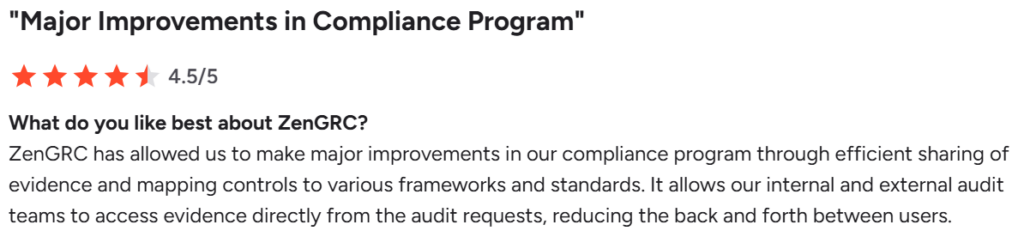
That means a control like access management or audit logging, tested once inside ZenGRC, satisfies requirements across all three frameworks simultaneously. Your team collects the evidence once, and ZenGRC applies it everywhere it maps.
3. Less Analyst Work on Your Plate
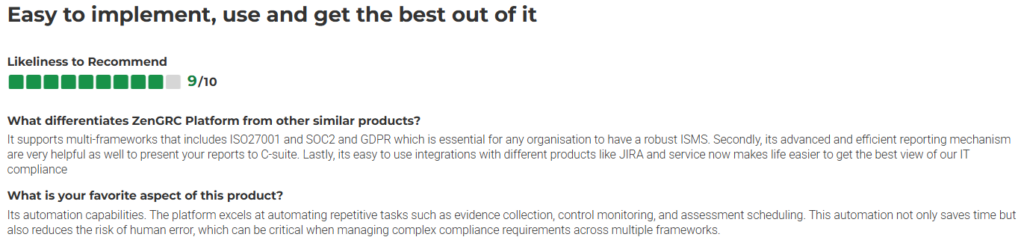
A mid-market compliance team running three frameworks generates a lot of routine work: control scoping, gap analysis, and vendor questionnaires. ZenGRC’s GRACI handles all of it. It scopes your program against your chosen frameworks, identifies gaps between your current controls and what HITRUST requires, and drafts vendor questionnaires your team would otherwise build manually.
4. Live Before Your 90-day Window Closes
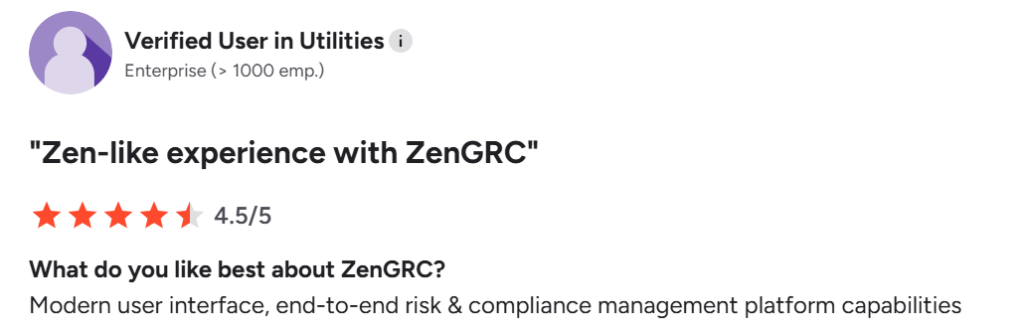
Many enterprise platforms take 6 to 12 months to stand up because they are built for organizations with dedicated implementation teams and nine-month procurement cycles. But ZenGRC gets your team live in under 60 days. If your HITRUST contract clause gives you 90, that leaves you 30 days of runway before your first audit cycle begins.
5. Your Costs Stay Flat as You Scale
Most software in this category charges per framework. Adding HITRUST on top of your existing SOC 2 and HIPAA program means a higher invoice. ZenGRC, however, charges a flat rate for unlimited users, frameworks, and vendors.
10 HITRUST Compliance Software for Mid-Market Teams Compared
Each GRC software and compliance automation tool on this list is evaluated to help you make the best choice.
1. ZenGRC
ZenGRC is a GRC software built for mid-market compliance teams managing multiple frameworks at once. It sits in the middle of the market deliberately. More depth than the entry-level tools. Faster to deploy than the enterprise ones.

ZenGRC is a HITRUST MyCSF integration partner with full bidirectional sync. Evidence and control data move in both directions between ZenGRC and MyCSF. It’s perfect for teams running HITRUST alongside HIPAA and SOC 2.
Key Features
- Map controls once across 40+ frameworks: That includes HIPAA, HITRUST, SOC 2, PCI DSS, and CMMC. Your team stops collecting the same evidence twice.
- Native MyCSF integration: Your HITRUST program lives in one place rather than split across two systems.
- 117+ integrations pull evidence automatically: Your team is always audit-ready without the manual scramble.
- GRACI AI: Handles control design, program scoping, gap analysis, and vendor questionnaires.
- SOC 2 Integrity Check: Validates vendor SOC 2 reports for scope gaps, control exceptions, and material issues.
- Controlled assessor access: Auditors see exactly what they need and nothing else.
- Real-time dashboards: Gives your leadership a live view of program health.
- Single-tenant architecture: Keeps your data in its own isolated environment. Separates you from every other customer.
Pricing
ZenGRC charges a flat rate for unlimited users, unlimited frameworks, and unlimited vendors. Your costs stay flat as your team grows and as you add frameworks. No per-user fees, per-framework charges, or annual renewal hikes.
Pros
- HITRUST program runs in one place
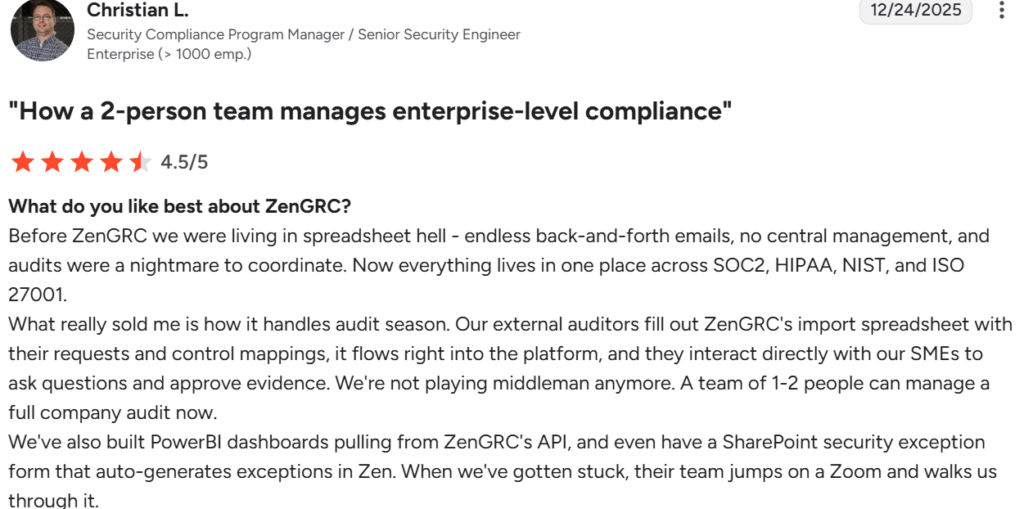
- Same evidence satisfies HIPAA, HITRUST, and SOC 2
- Supports 40+ frameworks out of the box
- Program data lives in its own isolated environment
- Teams can run the platform without a dedicated admin
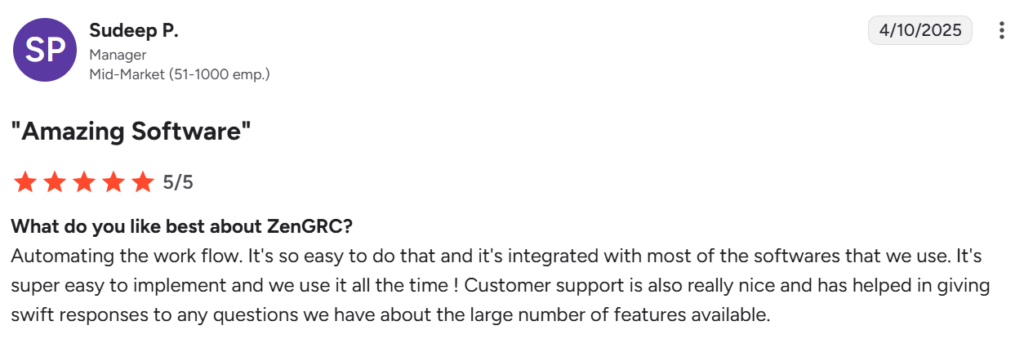
- Implementation support and a dedicated customer success manager
Cons
- Not the right fit for solo compliance owners doing their first single framework
2. Hyperproof
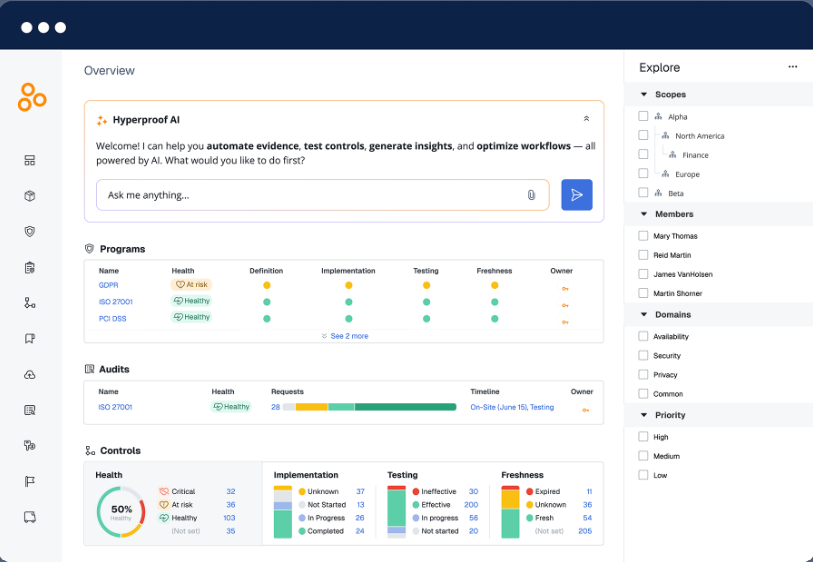
Hyperproof is a GRC platform with solid multi-framework support. It handles HITRUST r2, i1, and e1. Hyperproof is a credible option for mid-market teams managing multiple frameworks. But you may find it thin if you need deep scoping and reporting.
Key Features
- Cross-framework control: Maps across multiple frameworks.
- Audit management: Includes assessor collaboration and evidence linking.
- Risk management: Includes risk evaluation and compliance monitoring
Pricing
Hyperproof does not publish figures publicly.
Pros
- Documented HITRUST experience across r2, i1, and e1
- Cross-framework control mapping across HIPAA, SOC 2, and HITRUST
- Dozens of integrations, including evidence collection
Cons
- No native MyCSF integration
- Thin scoping and reporting depth
- Costs climb significantly at scale if you rely on MSPs
3. AuditBoard (now Optro)
AuditBoard (now Optro) started as a SOX and internal audit tool. It has since expanded into broader GRC. While teams with GRC admins and professional services budgets might find it a good fit, there are better options for mid-market companies.
.
Key Features
- Audit management: Includes autonomous testing, compliance and ops audit
- Risk management: Includes continuous monitoring and enterprise risk reporting.
- Compliance management: Includes HITRUST, SOC 2, HIPAA, and ISO 27001.
Pricing
AuditBoard does not publish pricing publicly.
Pros
- Deep audit management functionality
- Quick and intuitive onboarding process
- Broad GRC coverage across audit, risk, compliance, and cyber risk
Cons
- Implementation for complex programs can be challenging

- Modules are siloed

- Users report a clunky interface

4. OneTrust
OneTrust covers GDPR, CCPA, AI governance, and third-party risk. If your compliance program is privacy-first, it is hard to argue with the breadth. But it does not really fit teams that do HITRUST, HIPAA, and SOC 2.

The platform was built through 10+ acquisitions, and it shows. Different modules, different interfaces, and different support teams, plus an implementation timeline to match.
Key Features
- Manage privacy and consent: Hundreds of regulations and frameworks.
- Compliance management: Maps your compliance program across HITRUST, SOC 2, and ISO 27001.
- Risk management: Map and monitor across your business ecosystem
Pricing
OneTrust does not publish pricing publicly.
Pros
- Comprehensive privacy and consent management
- Broad framework coverage
- Wide range of automated evidence collection options
Cons
- Core GRC is a secondary use case for OneTrust
- Different modules were built through separate acquisitions
- Steep learning curve and slow implementation

5. Vanta
Vanta is a useful starting point for a lot of mid-market compliance programs. It’s fast to deploy, heavily automated, and good at getting teams through their first SOC 2 or HIPAA certification. Vanta has since added HITRUST support.

But still, Vanta works better for teams handling one or two frameworks. If your team manages multiple frameworks simultaneously, you will likely outgrow it.
Key Features
- Automated compliance: Maps across 35+ frameworks.
- Two-way MyCSF: HITRUST evidence sync integration.
- Continuous evidence collection: Collects evidence across 400+ integrations.
Pricing
Costs are structured around employee count, number of frameworks, and add-on modules. Costs increase significantly for a mid-market team running HITRUST alongside HIPAA and SOC 2.
Pros
- Fast to deploy for SOC 2
- Strong trust centre
- Extensive automated evidence collection library
Cons
- Pricing around framework and users increases costs when you add a certification
- Built for compliance owners doing their first framework
- Annual renewal increases can be steep
6. Drata
Drata sits in the same category as Vanta. It is built for companies working through their first or second compliance certification.
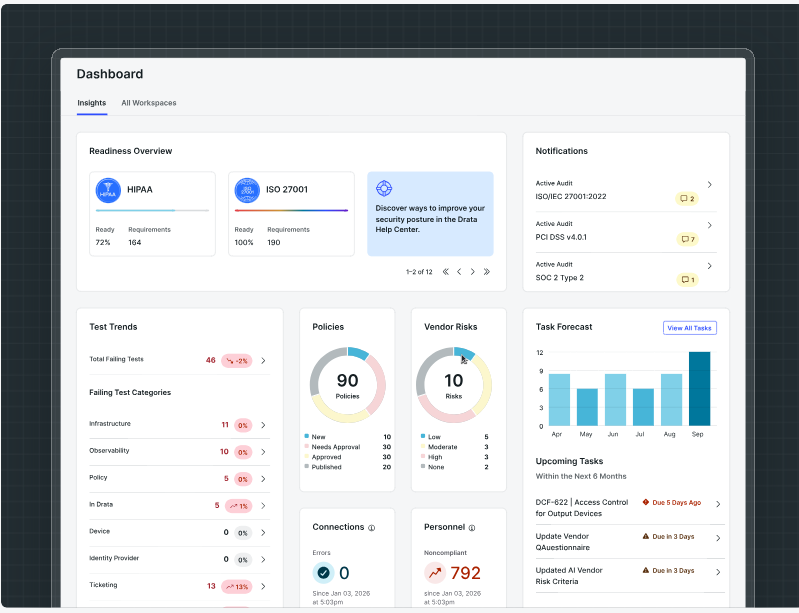
But for HITRUST specifically, Drata has a meaningful gap. The platform supports HITRUST r2 workflows, but teams still need to manually map controls in places, so it does not eliminate the hands-on work entirely
Key Features
- Automated compliance: Includes SOC 2, ISO 27001, HIPAA, and GDPR.
- Continuous evidence collection: Collects evidence across over 200 integrations.
- Custom framework builder: Customizes compliance requirements beyond standard templates.
Pricing
Drata does not publish figures publicly.
Pros
- Advanced risk management module
- Fast to deploy for SOC 2 and ISO 27001
- Clean, intuitive interface
Cons
- No native MyCSF integration
- Per-framework pricing means costs grow every time you add a certification
- r2 support is not fully there yet
7. Secureframe
Secureframe is a compliance automation platform built around SOC 2, ISO 27001, and HIPAA. HITRUST is not a core strength, and it also has no native MyCSF integration.

If HITRUST r2 is your current primary driver, Secureframe may be short on depth.
Key Features
- Automated compliance: Includes 35+ frameworks.
- Continuous evidence collection: Collects evidence across 300+ integrations.
- Risk management: End-to-end risk management in your environment.
Pricing
Secureframe publishes three tiers: Fundamentals, Complete, and Defense. You will need the Complete tier at a minimum to run HITRUST alongside HIPAA and SOC 2.
Pros
- Fast to deploy for SOC 2
- Strong customer support
- Highly intuitive user interface
Cons
- No native MyCSF integration
- Multi-framework support runs thin at scale
- Workflow flexibility is limited for complex programs.

8. OnSpring
OnSpring is a no-code GRC software that supports a range of compliance frameworks.

The platform is not purpose-built for HITRUST, but it is configurable. That means it can handle HITRUST, depending on how well you set it up.
Key Features
- Compliance management: Includes HITRUST, HIPAA, SOC 2, PCI DSS, CMMC, and NIST.
- Internal audit management: Includes automated workflows, control, and audit-ready reporting.
- Third-party risk management: Includes vendor access, assessments, and remediation.
Pricing
Onspring uses a subscription-based pricing model, structured by the number of users and selected modules.
Pros
- Highly customizable on an open architecture
- Reliable professional services team
- Responsive user interface, though reporting has limitations.
Cons
- Implementation typically takes 3 to 6 months
- Steep learning curve before your team is running independently
- G2 reviews highlight clunky reporting

9. Thoropass
Thoropass is a compliance platform with a different model from the others on this list. It is both the software and the audit firm.
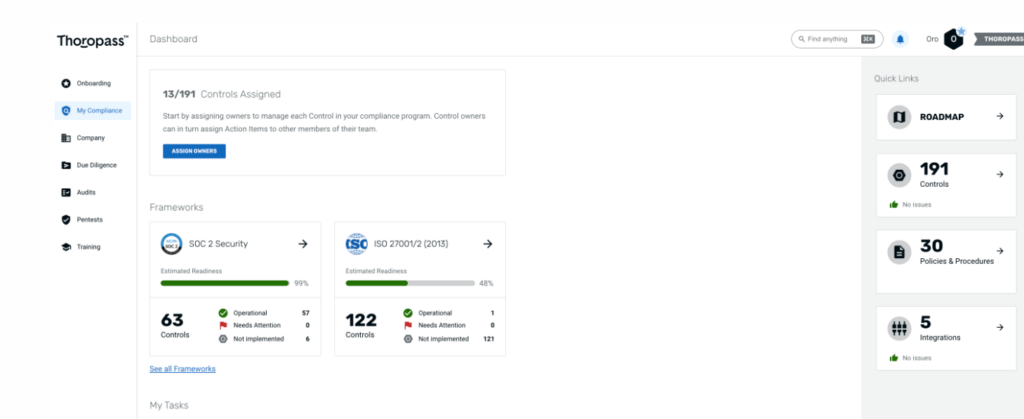
HITRUST is a core framework, but the platform is template-driven. You may find it difficult to adapt to your non-standard workflows.
Key Features
- Compliance management: Includes SOC 2, HIPAA, GDPR, HITRUST.
- In-house CPA firm: Handles your audit on the same platform.
- Cross-framework control mapping: Maps control across multiple frameworks.
Pricing
Thoropass does not publish pricing publicly.
Pros
- HITRUST, SOC 2, and HIPAA run in one platform with cross-framework evidence mapping
- No need to coordinate between your GRC tool and a separate external firm
- Dedicated compliance expert from day one
Cons
- Costs grow every time you add a certification to your program
- Template-driven platform

- Basic evidence collection and limited customization has been flagged by users as a constraint

10. LogicGate
LogicGate is an enterprise GRC software with a dedicated HITRUST application. It is capable if your team needs deep risk quantification alongside compliance.
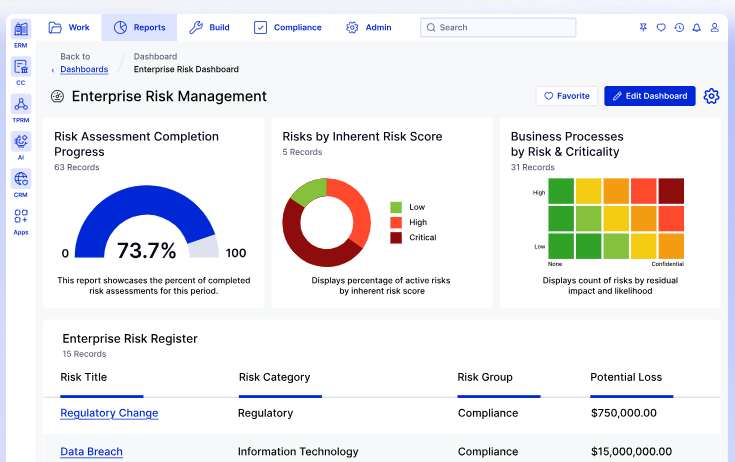
But it is a highly flexible system. You will need dedicated GRC admins to configure it properly.
Key Features
- HITRUST Controls Compliance application: Includes pre-built assessment workflows and automated evidence collection.
- Cross-framework control mapping: Maps controls across 25+ frameworks.
- Monte Carlo simulations and the Open FAIR model: Manages enterprise risk.
Pricing
LogicGate does not publish pricing publicly.
Pros
- Strong HITRUST Controls Compliance application
- A credentialed platform your procurement team may recognise
- Deep risk quantification capability
Cons
- Steep learning curve

- AI features are still maturing
- Built for enterprise teams with dedicated GRC admins

Handle Your HITRUST Program in One Place With ZenGRC
When your GRC platform doesn’t support HITRUST, your team ends up stitching the program together manually, increasing the risk of errors and creating unnecessary audit stress. That’s why adopting a platform built for the HITRUST Assurance Program is the right security move.
ZenGRC delivers more depth and control than entry-level tools, while getting started faster than heavyweight enterprise platforms. As an HITRUST MyCSF integration partner, it enables you to manage your entire HITRUST program in one centralized system from day one.
If you’re managing HITRUST alongside HIPAA or SOC 2, request a demo and see how ZenGRC handles it.
FAQs
1. How do I choose between HITRUST compliance software tools?
When evaluating HITRUST compliance software, focus on four essentials: native MyCSF integration to avoid running dual systems; strong multi-framework support with live cross-mapping; fast time to value measured in weeks, not months; and scalable pricing that won’t spike as your team or framework count grows. A platform that has all four is built for a lean compliance team managing HITRUST alongside HIPAA and SOC 2.
2. Does HITRUST compliance software replace a HITRUST assessor?
No. HITRUST certification requires a validated assessment by an authorised external assessor. No software changes that.
3. What is HITRUST MyCSF, and do I need an integration?
MyCSF is HITRUST’s own assessment management platform. It is where your external assessor works during the certification process. Without integration, your team needs two systems.
4. How long does it take to implement HITRUST compliance software?
It depends on the tool. Entry-level platforms can be live in days. Mid-market tools like ZenGRC typically go live in under 60 days. Enterprise platforms can take six to twelve months.
5. Can I manage HITRUST, HIPAA, and SOC 2 in the same platform?
Yes, but not every platform does it well. The key is cross-framework control mapping. A control that satisfies HIPAA often satisfies HITRUST and SOC 2 as well. The right platform maps that once and applies it everywhere.