
Founded in 2009, ZenGRC offers robust, intuitive products that help organizations graduate from manual processes and point solutions, turning compliance and risk management into a source of business advantage. We help organizations better navigate the complexities of governance, risk, and compliance.
What You Need To Know: The Importance of Compliance in Healthcare
- Healthcare compliance is a legal, financial, and operational requirement. A single breach can trigger investigations, corrective action plans, and customer loss simultaneously.
- Compliance in healthcare is not one framework. Most organizations manage HIPAA, HITRUST, SOC 2, and others at the same time, with overlapping controls and separate audit cycles.
- The organizations that handle compliance well treat it as a program, not a project. That means dedicated ownership, the right tooling, and a system that runs continuously rather than spinning up before each audit.
Healthcare compliance sits at the intersection of patient safety, data security, and business viability. Get it wrong and the consequences arrive from multiple directions at once: regulators, customers, auditors, and the board.
For security and compliance leaders, the question is not whether compliance matters. It is how to build a program that manages it without burning out a lean team. In this article, we’ll explore the importance of compliance in healthcare and how it can cost your team if done wrong.
Table of contents:
- What makes healthcare compliance different
- The cost of getting it wrong
- The cost of doing it manually
- Why compliance in healthcare requires a program, not a project
- What this means for how you build and staff compliance
- See how ZenGRC supports healthcare compliance programs.
What makes healthcare compliance different
Most industries have one primary compliance framework. Healthcare has several, and they overlap in ways that create real operational complexity.
HIPAA governs how protected health information is handled. It applies to every covered entity and business associate, with no revenue threshold and no size exemption. A five-person health tech startup and a 50,000-person health system are both subject to the same rules.
HITRUST has become the de facto security certification standard for organizations working with enterprise payers and health systems. It is not legally required. But for many health tech companies, it is a commercial requirement. Customers ask for it. Contracts require it. Deals stall without it.
SOC 2 is increasingly expected alongside HITRUST, particularly for software vendors handling PHI. NIST and ISO 27001 appear in federal and international contexts. PCI DSS applies wherever payment data intersects with health data.
The result is that most healthcare compliance teams are managing 3, 4, or 5 frameworks simultaneously. Each has its own audit cycle, its own evidence requirements, and its own reporting structure.

The cost of getting it wrong
Healthcare compliance failures are expensive. They are also public.
HIPAA violations are tiered by culpability. Tiers 1 can be as low as $145, while Tier 4 can be as high as $2,190,294 per year. However, a settlement is not just a financial hit. It is a reputational one.
Beyond regulatory penalties, compliance failures create customer risk. Health systems and payers require compliance certifications before signing contracts. Losing a certification, or failing to renew one on time, can trigger contract reviews and customer churn.
Audit findings create operational drag. A corrective action plan from a HITRUST assessment means additional remediation work, additional documentation, and a follow-up assessment cycle. Every finding that could have been caught earlier costs more to fix later.
The teams that treat compliance as a continuous program rather than a periodic audit sprint catch findings earlier, fix them faster, and spend less time in remediation.
The cost of doing it manually

The operational cost of healthcare compliance is significant even when nothing goes wrong.
Manual evidence collection consumes weeks of team time per audit cycle. The same evidence that satisfies HIPAA access control requirements also satisfies HITRUST and SOC 2. But most teams collect it separately for each framework because their tools do not connect the controls.
Spreadsheet-based programs create single points of failure. When the person who built the tracker leaves, the program knowledge leaves with them. There is no audit trail, no version history, and no way to produce documentation quickly when an auditor asks for it.
Leadership reporting is difficult without a real-time view of program health. Compliance leaders spend time assembling status updates that should be available on demand.
This is not a niche problem. It is the default state for most healthcare compliance teams that have not yet invested in purpose-built tooling.
Why compliance in healthcare requires a program, not a project
A project has a start and an end. A compliance program does not.
HITRUST certification runs on a two-year cycle with interim assessments. HIPAA risk analysis is annual. SOC 2 is annual. The audit cycle does not pause between certifications. Evidence needs to be collected continuously, not assembled in the weeks before each audit.
A program approach means:
- Dedicated ownership with clear roles across the compliance team
- Controls mapped across frameworks so evidence collected for one satisfies many
- Automated evidence collection running continuously against integrated systems
- Audit readiness as a default state, not a pre-audit sprint
- Real-time reporting so leadership has visibility without manual status updates
The difference between a project and a program is what happens between audits. A project goes dormant. A program keeps running.
What this means for how you build and staff compliance
Now that we’ve addressed the importance of compliance in healthcare, it’s important leaders treat compliance as a program so they can structure their teams and tooling differently.
They invest in a platform early. The cost of managing compliance in spreadsheets is not zero. It is paid in team hours, audit findings, and the risk of a breach or violation that could have been caught with better visibility.
They map controls across frameworks from the start. Adding HITRUST to an existing HIPAA program is significantly easier when the controls are already mapped and the evidence is already organized. Doing it retroactively, in spreadsheets, is one of the most common reasons healthcare compliance programs stall.
They treat audit readiness as a continuous state. Teams that prepare for audits in sprints spend more time on compliance, not less. Continuous evidence collection means the audit is a review, not a scramble.
For a detailed look at how to structure the operational side of a healthcare compliance program, see Managing Compliance in Healthcare.
See how ZenGRC supports healthcare compliance programs.
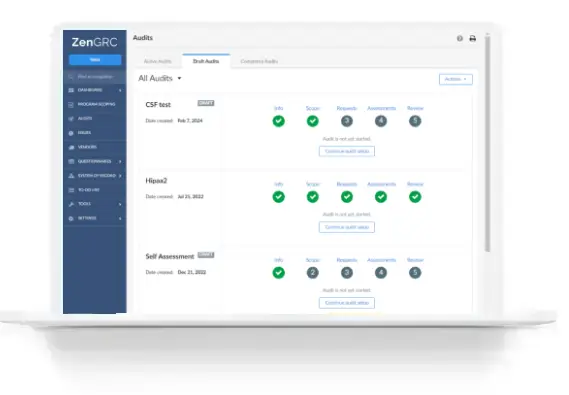
ZenGRC maps HIPAA and HITRUST controls in one platform. It connects to 117 integrations for automated evidence collection. It runs on a single-tenant architecture so your program data stays yours. And it goes live in weeks, not months.
Request a demo to see how ZenGRC handles the full healthcare compliance program.