

If you run a compliance program with monthly, quarterly, or continuous evidence requirements, this is probably already costing you time you can’t see yet. Here’s what’s actually happening, what it costs, and how to structure it so it doesn’t.
What Recurring Evidence Collection Actually Means
Recurring evidence collection covers any control that needs proof on a set cadence, not once a year. Access reviews, backup verification, vulnerability scans and vendor attestations are common examples.
Most teams already work this way. In a July 2026 survey of 201 security and compliance practitioners, 80.6% said they collect evidence throughout the year. Only 9.5% still rely on annual assessments. [1]
A SOC 2 program can easily carry ten or more controls that need monthly evidence. Each one produces 12 proof points a year, before you add a second or third framework.
The problem isn’t the cadence. It’s how most tools and spreadsheets store the results. Every time the cycle repeats, they create a brand-new task or record instead of adding to the one that already exists.
Why This Breaks: The Fragmentation Problem
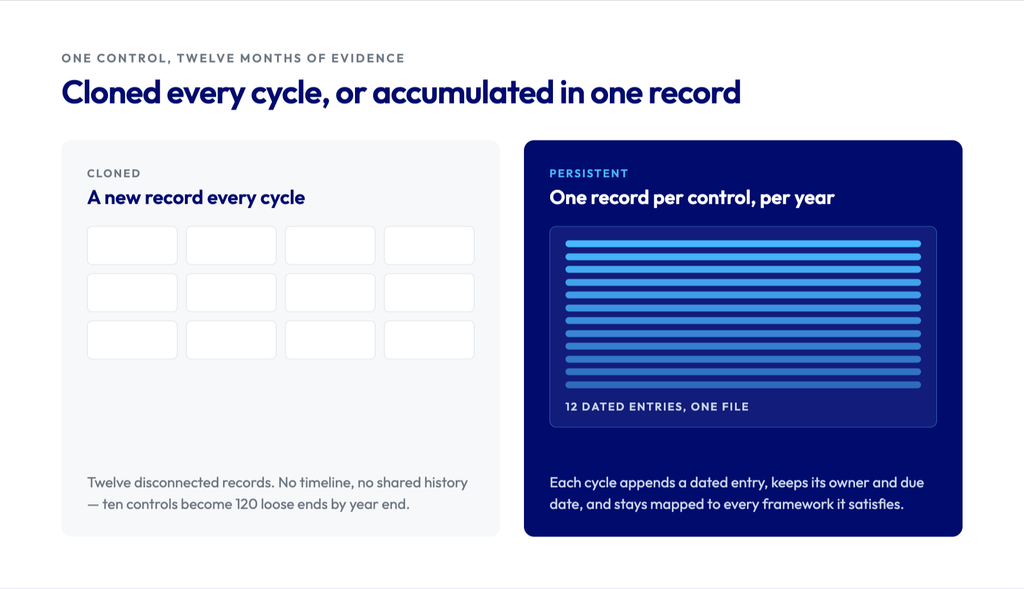
The mechanism is the same on a platform or in a folder of spreadsheets.
A recurring task is set to repeat monthly. Each time it fires, it creates a new instance. That instance often gets a new ID. Sometimes it goes to a default owner instead of the person responsible. It has no link to any prior instance.
Ten controls on a monthly cycle produce 120 separate task records by year end. None of them reference each other. None of them build a timeline.
When the auditor asks for evidence, someone has to rebuild twelve months of proof for every control by hand. That rebuild is where the real cost lives.
Three patterns show up again and again:
Evidence fragmentation. One control’s yearly evidence lives in a dozen or more disconnected records instead of one continuous file.
Silent data drift. Due dates and owners can revert to their original setup values each cycle. The record stops reflecting who does the work and when it’s due.
Missed cycles. When a schedule gets edited mid-year, some systems skip the cycle that should have fired. Nobody notices until the auditor finds a gap in the timeline.
Three Real Programs That Hit This Wall
These are anonymized composites drawn from real compliance team conversations. Names and identifying details have been removed.
A media and entertainment services company, five years into their compliance program
A long-tenured compliance lead was building monthly SOC 2 evidence collection ahead of an annual audit with a large external audit firm. Ten controls needed monthly proof. Each cycle created a new record instead of adding to the original. Due dates and owners kept reverting to their setup values. By year end, that was 120 disconnected records for ten controls. Because the auditor reviewed the evidence chain directly, this wasn’t an internal annoyance. It was an integrity question with an outside firm watching.
An offshore engineering and marine services firm
A small compliance function, staffed part-time, raised the same issue in two separate working sessions. Their audit structure created a new request every month rather than building on the last one. At year end, there was no continuous trail to point to. For a team already stretched thin, rebuilding that trail by hand amounted to a second full compliance cycle on top of the first.
A marketing technology company managing access recertification
This team ran about 19 access recertifications on a three-month cycle. When a schedule date was edited after the next cycle had already passed, that cycle simply didn’t happen. The team had to find and recreate each missed record by hand. For a team whose daily work depends on recurring reviews, constant manual patching turned into a real operational drag.
Three industries. Three team sizes. One structural failure: evidence that should build up in one place splinters into records that don’t talk to each other.
What This Actually Costs
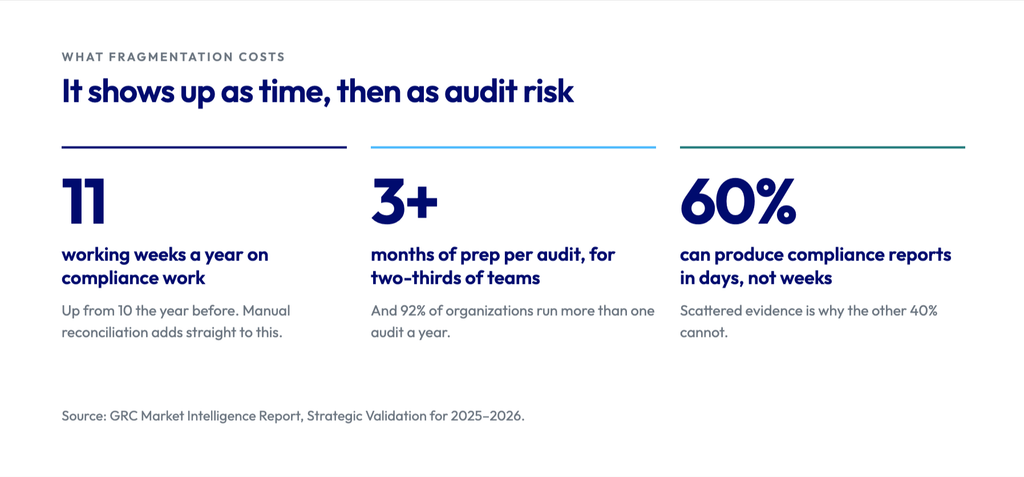
Fragmentation doesn’t show up as one big line item. It shows up as time, audit risk and lost trust, and each one compounds.
Time. Practitioners say collecting evidence takes more of their time than validating it or proving remediation. [1] Nearly 90% manually remap or re-document at least some evidence across frameworks. Only 6.5% say their tooling handles most of that mapping. [1] Rebuilding a year of scattered records adds days of cross-checking dates, owners and file versions on top.
Audit risk. Confidence fades between audits. 93% of practitioners believe certification reflects their security posture, but only 51.2% believe it does so continuously. [1] Among teams who trust their certification only right after an assessment, just 16.7% would feel very confident in a next-day audit. [1] A fragmented trail is a big reason why. Auditors who see gaps ask for more documentation, flag findings or extend the engagement.
Team trust in the system. When due dates and owners silently reset every cycle, people stop trusting the data. They go back to the shadow spreadsheets the GRC program was supposed to replace.
Business impact. This is part of a bigger pattern. In PwC’s 2025 Global Compliance Survey, 77% of organizations said compliance complexity had hurt them in five or more areas that drive growth. [2] Fragmented evidence is one of the most avoidable sources of that complexity. And it surfaces when it’s most visible: audit time.
How to Structure Recurring Evidence Collection Correctly
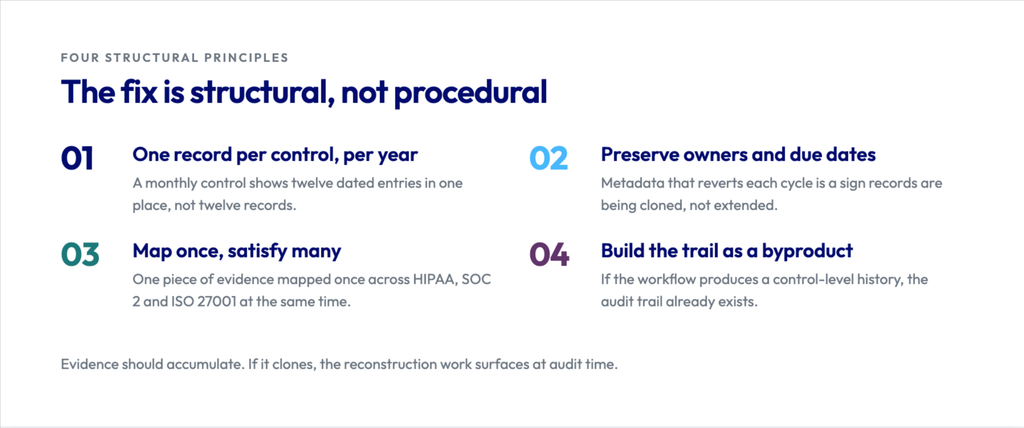
The fix isn’t more process. It’s a different structure underneath. Four principles hold up in every program we’ve seen work well.
1. One persistent record per control per year. Evidence should build up inside one continuous file for each control. A monthly control should show twelve dated entries in one place, not twelve records scattered across the system.
2. Keep owners and due dates across cycles. If a control belongs to a specific person, every cycle should keep that assignment unless someone changes it on purpose. Values that reset each cycle are a sign the system is cloning records instead of extending them.
3. Map evidence once, reuse it everywhere it applies. If one piece of evidence satisfies HIPAA, SOC 2 and ISO 27001, map it once. Map once, satisfy many. Uploading the same proof separately for each framework is the duplicated work a control-mapped structure removes.
4. Pull evidence automatically where you can. Practitioners rank continuous, automated evidence generation as the single improvement that would help their programs most. [1] Integrations that pull evidence from source systems on a schedule remove the manual upload step entirely.
Get these right and the audit trail becomes a byproduct of the work, not a year-end project. You stop “preparing” for audits. You prove control effectiveness on demand.
What to Look for in a GRC Platform Before You Trust It with Recurring Evidence
If you’re evaluating tools, or auditing your current one, ask these questions directly:
- Does a recurring task add to an existing record, or clone a new one every cycle?
- Do due dates and owners carry over across cycles, or reset to their original values?
- If a schedule changes mid-year, does the system catch up on missed cycles?
- Can one piece of evidence be mapped to multiple frameworks at once?
- Can the system pull evidence from source systems on a schedule, instead of relying on manual uploads?
- When an auditor asks for a year of history on one control, can you produce it in minutes, not days?
A platform built for multi-framework, mid-market compliance teams should answer yes to all six. If a demo can’t show you a continuous, control-level evidence history, that gap will show up at audit time.
FAQ
What is recurring evidence collection in GRC?
Recurring evidence collection is the ongoing process of gathering proof that a control is being performed on a set schedule, such as monthly access reviews or quarterly vendor attestations, rather than a one-time annual check.
Why does recurring evidence collection break audit trails?
It breaks down when the underlying system creates a new, disconnected record every time the task repeats instead of adding to one continuous file. A year of monthly evidence for a single control can end up scattered across a dozen or more unlinked records, which makes it hard to reconstruct a clean history for auditors.
How many task records does a typical SOC 2 monthly evidence program generate in a year?
A program with ten controls requiring monthly evidence generates roughly 120 separate task instances a year if the system clones a new record on every cycle instead of appending to one.
What’s the fix for evidence fragmentation?
Structure recurring evidence around one persistent record per control per year. Each cycle should add a dated entry to that record, preserve the original owner and due date, and stay mapped to every framework the evidence satisfies.
Does cross-framework control mapping help with recurring evidence collection?
Yes. Mapping one piece of evidence to every framework it satisfies, instead of collecting it separately for each framework, cuts duplicated work and keeps the audit trail consistent across SOC 2, HIPAA, ISO 27001, and other overlapping requirements.
How much time do compliance teams spend on audit prep?
Two-thirds of organizations spend at least three months a year preparing for each audit, and the average time spent on compliance overall grew from 10 working weeks in 2023 to 11 in 2024.
Sources
[1] Pentest-Tools.com, “Compliance audit cycles: what 201 practitioners experience,” July 2026. https://pentest-tools.com/insights/compliance-cycles-survey
[2] PwC, “Global Compliance Survey 2025.” https://www.pwc.com/gx/en/issues/risk-regulation/global-compliance-survey.html