
10 Hyperproof Alternatives in 2026
Quick Summary
Leaving Hyperproof is rarely about one broken feature. It’s usually that your program grows. So the tool you set up for a first audit now has to carry HITRUST, vendor risk, and three audit timelines at once. The alternatives worth your time fall into three camps, and knowing your camp cuts the shortlist down fast. ZenGRC is the ideal alternative for multi-framework compliance.
The three we’d look at first:
| # | Tool | Best for |
| 1 | ZenGRC | Several frameworks at once, especially HIPAA, HITRUST, and SOC 2 |
| 2 | AuditBoard (now Optro) | Large internal audit and SOX programs |
| 3 | OneTrust | Privacy and compliance together |
Why Look for a Hyperproof Alternative?
While Hyperproof is good for teams outgrowing compliance automation point tools, some organizations are exploring alternatives that better align with their specific requirements. A platform that suits a 300-person software company won’t automatically suit a healthcare group carrying HIPAA, HITRUST, and SOC 2 at once.
Here’s why teams move on from Hyperproof:
1. Your program went multi-framework, and one framework carries the weight
Broad coverage and deep coverage aren’t the same thing. A platform can list a framework and still leave the hardest part of it outside the tool. HITRUST is the clearest example. It’s listed among Hyperproof’s 160+ frameworks, but a MyCSF integration isn’t named on its integrations page, which names Asana, Jira, and ServiceNow.
So if your assessment lives in MyCSF and your program management lives elsewhere, you’re keeping two systems in step by hand. Teams running several frameworks at once feel this first.
2. You can’t size the cost before you talk to sales
Budget constraints are a significant consideration, and not just for smaller companies. Hyperproof doesn’t publish pricing, so there’s no figure you can take to a budget conversation. That’s normal here, and nine of the ten tools below do the same. It matters anyway. When nobody publishes a number, what you can compare is the pricing model, and the models differ a lot.
Some vendors charge per admin user, some per application, some per framework, and a few charge one flat rate. That difference decides whether your fourth framework next year is free or a renewal conversation.
3. Adoption stalls outside the compliance team
A platform’s ease of use significantly affects the adoption rate within an organization, and the people who decide that aren’t compliance professionals. They’re the engineer who owes you an access review and the vendor manager who owes you a questionnaire. If those people have to learn a GRC tool to hand you one file, they’ll put it off. Then you’re chasing evidence over email again, which is the spreadsheet problem in a nicer interface.
The 10 Best Hyperproof Alternatives for GRC
| # | Tool | Best for | Pricing model | Frameworks | Watch out for |
| 1 | ZenGRC | HIPAA, HITRUST and SOC 2 together | Flat rate, unlimited users and frameworks | 30+, HITRUST e1, i1 and r2 native | Smaller named library than 160+ |
| 2 | AuditBoard (now Optro) | Enterprise audit and SOX | Unlimited stakeholder licenses | 30+ preloaded | HITRUST not named on its frameworks page |
| 3 | OneTrust | Privacy and compliance together | Metered per solution, on admin users and inventory size | 50+ on Compliance Automation | Compliance is one of six solution areas |
| 4 | LogicGate Risk Cloud | Custom GRC workflows | Per Application, plus Power User licenses | 25+ | Implementation packages run 30 to 150 days |
| 5 | ServiceNow IRM | Existing ServiceNow shops | No pricing page at all | No count published | Value depends on owning the platform |
| 6 | Archer | Banks and regulated enterprises | No pricing page at all | 8,000+ regulatory sources, 230+ jurisdictions | More machinery than a SOC 2 program needs |
| 7 | LogicManager | Board-level enterprise risk | Job-to-be-Done, unlimited users, advisory included | Risk Maturity Model across COSO, ISO, NIST, OCEG | Built ERM-first, so compliance is a use case |
| 8 | Vanta | A first SOC 2 or ISO 27001 | Essentials, Plus and Professional plans | SOC 2, ISO 27001, GDPR, HIPAA, HITRUST, ISO 42001 | Essentials includes one framework |
| 9 | Drata | Continuous monitoring, cloud-native | No named tiers published | SOC 2, ISO 27001, ISO 42001, GDPR, HIPAA, PCI DSS | No published tiers to compare |
| 10 | Secureframe | CMMC and defense contractors | Fundamentals, Complete, Defense | Matrix lists 1 framework on two packages | Extra frameworks cost more |
1. ZenGRC
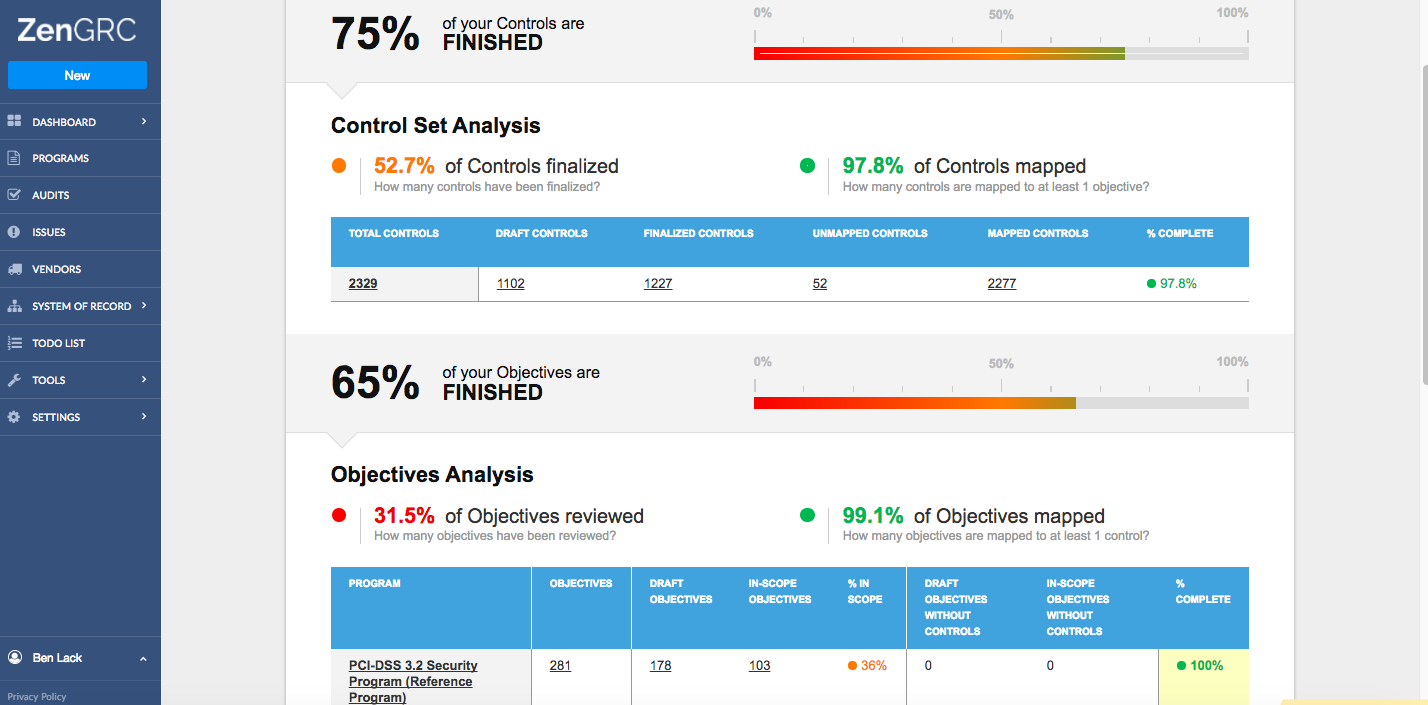
ZenGRC is a governance, risk and compliance platform built for teams running multiple frameworks. We built it around keeping controls, evidence, and audits connected.
The mechanism that matters is cross-framework control mapping. You test a control once, and that evidence applies everywhere it overlaps. So a HITRUST artifact also satisfies the HIPAA and SOC 2 requirements it maps to. That’s the difference between a program that gets heavier with every framework and one that doesn’t.
Key Features
- Cross-Framework Control Mapping: Test once and apply evidence across SOC 2, HIPAA, HITRUST, and 40+ frameworks.
- GRACI AI: Agentic AI trained only on your company data for control design, gap analysis, and program scoping.
- Flat-Rate Unlimited Pricing: No per-framework or per-user fees with predictable annual costs.
- Named Support, Not a Ticket Queue: A dedicated CSM and real phone support come with every account
- HITRUST Integration: One of only four featured HITRUST partners with direct API and MyCSF integration
Best for
Compliance teams carrying several frameworks at once, particularly HIPAA, HITRUST and SOC 2 together, who want one platform instead of a stack of point tools.
Pricing
ZenGRC doesn’t publish dollar figures, so pricing is quoted per account. The model is flat and predictable, with one rate covering unlimited users, frameworks, and vendors, so adding a fourth framework doesn’t change what you pay.
Pros
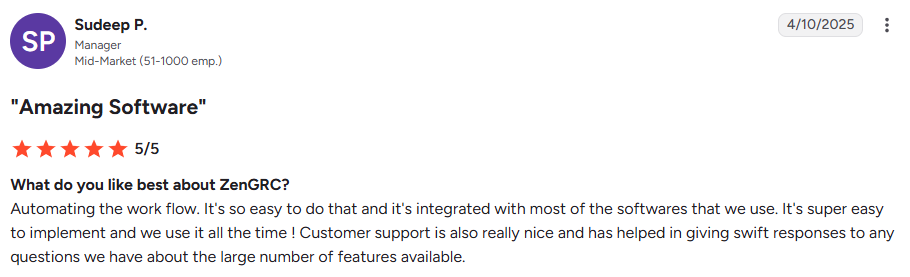
- 40+ frameworks are supported form day 1
- Native MyCSF API syncs evidence and control responses both ways
- Same evidence satisfies HIPAA, HITRUST, and SOC 2
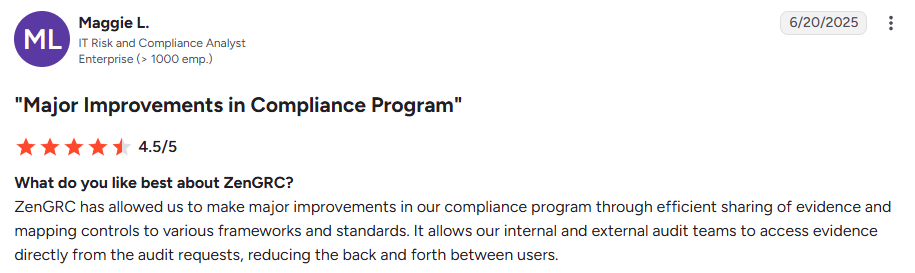
- A named CSM, phone support, and guided implementation come with every account
Cons
- Solo owners or small teams of two people may find the platform too much for their needs
2. AuditBoard (now Optro)
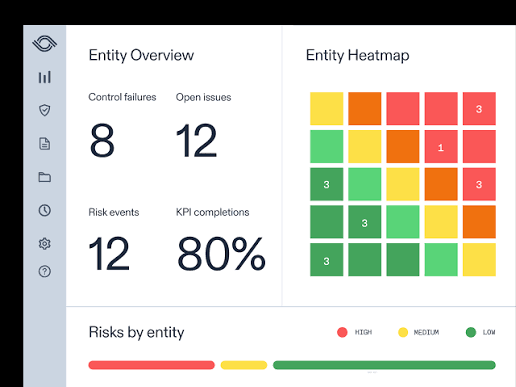
AuditBoard rebranded to Optro in March 2026, and auditboard.com now redirects to optro.ai. You’ll see both names for a while yet. It started in 2014 as SOXHUB, built by two former internal auditors, and that origin still shows.
It’s now a ten-product connected risk platform. What separates it from compliance-first tools is audit lineage. Internal audit, SOX testing, and compliance sit on the same records, so a finding and the control it came from live together.
Key Features
- Audit management: Includes autonomous testing, compliance and ops audit
- Risk management: Includes continuous monitoring and enterprise risk reporting.
- Compliance management: Includes HITRUST, SOC 2, HIPAA, and ISO 27001.
Best for
Large organizations where internal audit and SOX drive the program, and compliance sits alongside them.
Pricing
No public pricing, so it’s quoted per account. The pricing page promises “predictable pricing” with “unlimited stakeholder licenses” and “zero fees for additional licenses”. The only route to a number is a demo.
Pros
- Unlimited stakeholder licenses with zero fees for extra users
- Audit, SOX testing and compliance share one record set
- White-glove implementation and success services are part of the offering
Cons
- HITRUST isn’t named among the frameworks on its own frameworks page
- After the rebrand, support subdomains, developer docs, and review-site listings still carry the AuditBoard name
- Ten products is too much for teams needing audit and compliance management
3. OneTrust
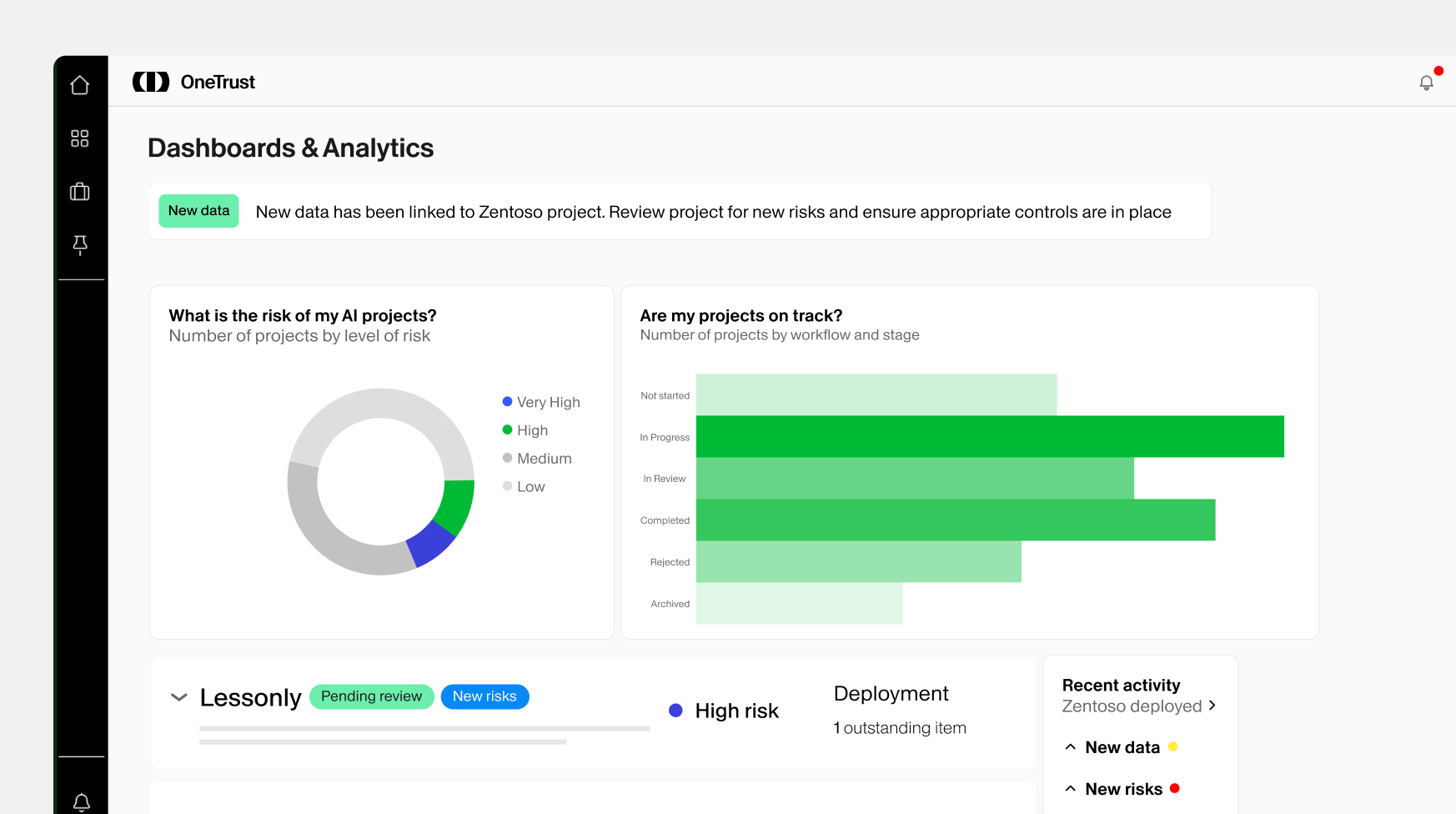
OneTrust is an enterprise governance platform split into six solution areas. Those are AI Governance, Consent and Preferences, Data Use Governance, Privacy Automation, Tech Risk and Compliance, and Third-Party Management. Compliance is part of Tech Risk and Compliance, which covers 50+ standards and frameworks.
Key Features
- Privacy and Consent: Global privacy management, cookie consent, and data governance.
- GRC and Compliance: Policy management, risk register, control testing, and audit workflows.
- ESG and Sustainability: Carbon accounting, supplier sustainability, and ESG reporting.
Best for
Organizations where privacy and security compliance are run by connected teams working from the same inventory of data and vendors.
Pricing
No public pricing, and it’s quoted per account, with each solution metered separately. Tech Risk and Compliance is priced on admin users and asset inventory. Third-Party Management is priced on admin users and third-party inventory.
Pros
- A shared evidence framework maps one artifact across 50+ frameworks
- 200+ data connectors, one of the deepest integration libraries in the category
- Privacy, consent, AI governance and third-party risk are one platform
Cons
- Metering on admin users plus inventory size means your bill grows as your asset and vendor lists grow
- Compliance is one of six solution areas, so you may configure more platform than the job needs
- HITRUST isn’t named on the Compliance Automation or Tech Risk and Compliance pages
4. LogicGate Risk Cloud
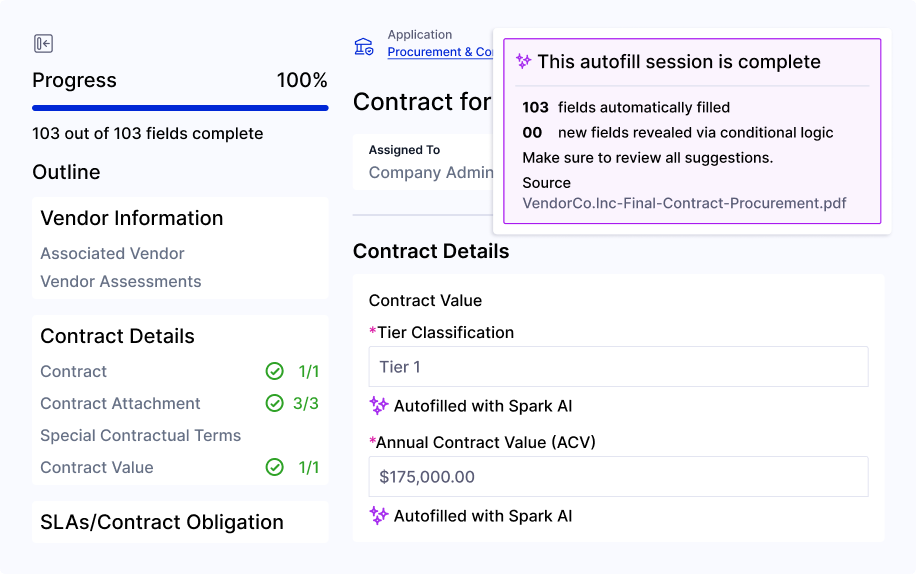
LogicGate Risk Cloud is a no-code GRC platform built on a flexible graph database, with 30+ Applications you combine to run a program. An Application is LogicGate’s word for a set of workflows covering one GRC use case. You assemble the program from parts instead of adopting a fixed one.
The graph database will model relationships almost any way you want, which helps when your process doesn’t match anyone else’s. But it starts empty, and you’re the one building it.
Key Features
- No-Code Workflow Builder: Design custom risk, compliance, and audit processes without developer resources.
- Risk Quantification: Calculate inherent and residual risk with custom scoring methodologies.
- Control Library: Build and map custom controls to any framework or internal standard.
Best for
Teams whose GRC process doesn’t fit an off-the-shelf model, with the capacity to design and maintain their own workflows.
Pricing
No public pricing, so it’s quoted per account. You buy the Applications you need, plus Power User licenses for the people running the program. Standard and External users are included at no extra cost, and services are separate line items.
Pros
- No-code graph database models control, risk, and vendor relationships however your program works, without developer time
- Standard and External user licenses are included
- LogicGate publishes exactly how Spark AI handles your data, including the 30-day OpenAI retention window
Cons
- Paying per Application plus per Power User means cost climbs as you add use cases and admins
- Published implementation packages run about 30 to 150 days, which is a long runway with an audit booked
- HITRUST isn’t named on its frameworks page, and no total integration count is published
5. ServiceNow Integrated Risk Management
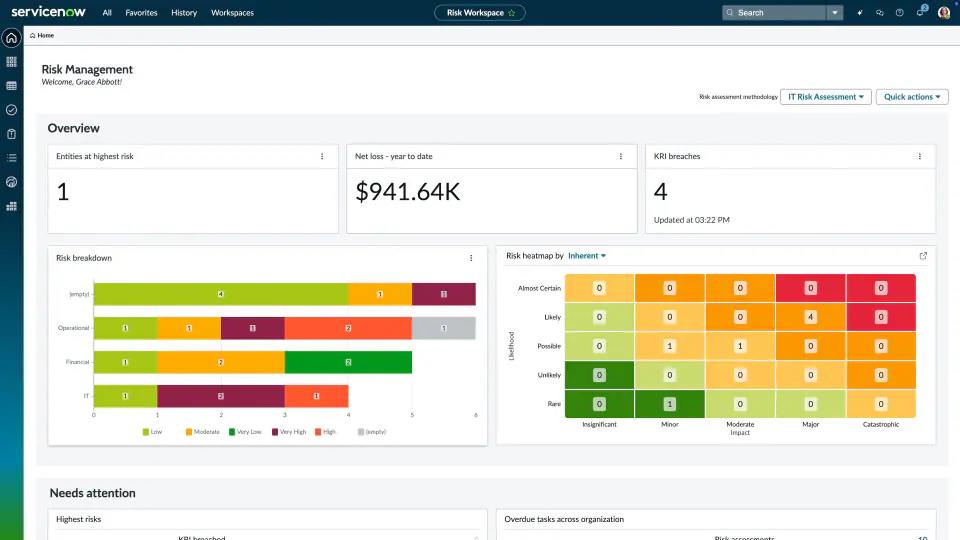
ServiceNow IRM runs on the ServiceNow AI Platform. It covers Enterprise Risk Management, Tech and Cyber Risk Management, Compliance and Continuous Assurance, Operational Risk Management, Operational Resilience and AI Governance. Policy and Compliance Management, Audit Management and Business Continuity Management sit underneath.
Its advantage is about what you already own. If your CMDB, incident queue and change management already live in ServiceNow, IRM reads your asset and change data instead of importing a copy. A control failure can raise a ticket where your engineers already work. If you don’t run ServiceNow, most of that advantage disappears.
Best for
Companies already standardized on ServiceNow, where IT service management and risk work should share the same asset data.
Pricing
ServiceNow doesn’t publish figures, tiers, or a pricing page for IRM. Total costs are quoted per account through sales.
Pros
- Reads asset, change and incident data straight from the ServiceNow CMDB
- Remediation tasks land in the queue engineers already work from
- Operational resilience and business continuity are first-class modules
Cons
- Value case rests on already owning ServiceNow
- No framework count is published anywhere, you can’t check coverage without a sales conversation
- Configuration is a ServiceNow platform skill, which usually means a partner or an internal admin
6. Archer
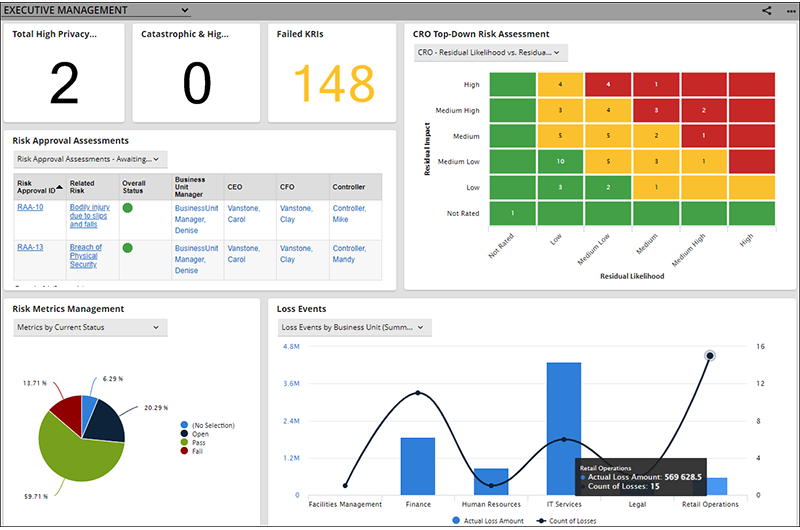
Archer calls itself the enterprise system of intelligence for GRC, and has been at it for 25+ years. The current lineup is three connected solutions, which are Archer Evolv Compliance, Archer Evolv Risk and Archer Evolv Intelligence. Audit management, ESG, resilience and third-party risk sit alongside them.
Regulatory change is where it goes deepest. Evolv Compliance monitors 8,000+ regulatory and standard-setting sources across 3,000+ agencies and 230+ jurisdictions. It then connects those changes to your obligations, controls and evidence, with full lineage from the source document to the outcome. That’s why 38 of the top 50 banks use it. It still offers on-premises deployment as well as SaaS.
Best for
Heavily regulated enterprises, especially banks and insurers, that have to prove which regulatory change drove which control update.
Pricing
Archer doesn’t publish figures, tiers, or a pricing page. You’ll need to contact the platform’s sales experts for a per account quote.
Pros
- Tracks 8,000+ regulatory sources across 230+ jurisdictions
- Full lineage from source regulation to evidence
- On-premises deployment is still supported
Cons
- The regulatory-change depth is more machinery than a standard GRC program needs
- Not suitable for small or growing teams
- Choosing between on-prem and SaaS adds an infrastructure decision to a software decision
7. LogicManager
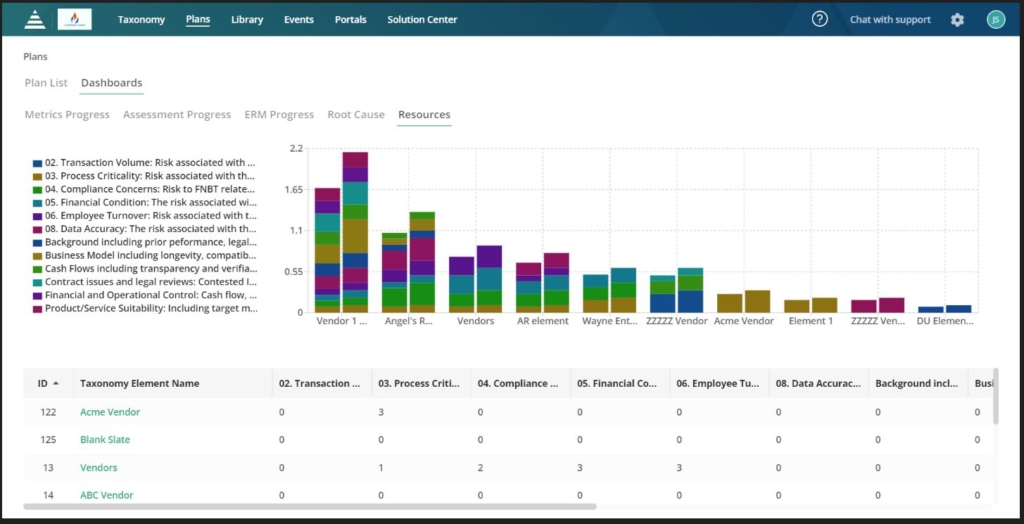
LogicManager is an enterprise risk management platform, and it’s refreshingly direct about being risk-led rather than compliance-led. Its own site says “Compliance Is the Minimum Standard. Mature ERM Drives Business Performance”, which tells you who it’s for.
The organizing idea is its Risk Maturity Model, an umbrella framework measuring the truths shared across COSO, ISO, NIST and OCEG. Instead of asking whether a control passed, it asks how mature your program is. That gives leadership something to take to a board. Risk Ripple Analytics traces how a risk in one department connects to exposure elsewhere.
Best for
Programs where the reporting line is a board or audit committee, and enterprise risk matters more than framework certification.
Pricing
No public pricing. It’s quoted per account, priced on a Job-to-be-Done basis, with discounts for multiple solutions. Users are unlimited, internal and external, and the price covers licensing, advisory service and onboarding. A 90-day unconditional money-back guarantee backs it.
Pros
- Unlimited internal and external users, with advisory service and onboarding inside the licence price
- Dedicated Advisory Analyst from day one
- 90-day unconditional money-back guarantee
Cons
- Built ERM-first, framework certification is only a use case on the platform instead of its design centre
- Risk Maturity Model is a methodology, so adopting it well is a program change
- No published framework library to compare against a 160+ list
8. Vanta
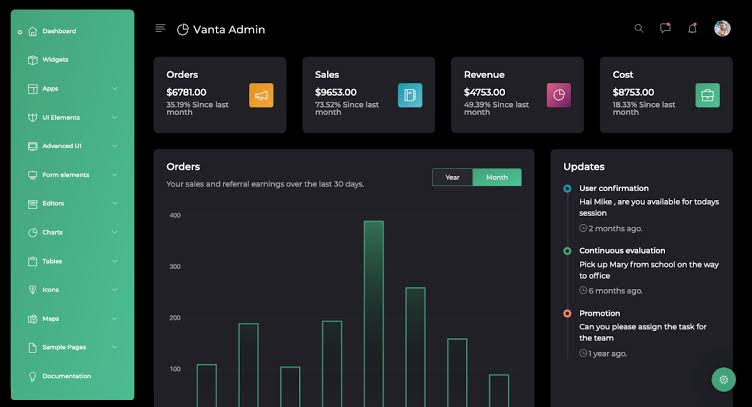
Vanta is a compliance automation platform, now positioned as an “agentic trust platform”. It covers Compliance, Continuous GRC, Personnel and Access, Risk Management, Third Party Risk Management, Questionnaire Automation, Trust Center and AI Governance. It names SOC 2, ISO 27001, GDPR, HIPAA, HITRUST and ISO 42001, and pulls data from 400+ tools.
The trade shows up in packaging. Essentials includes one compliance framework, questionnaire automation is capped at 25 a year on Plus, and risk and reporting arrive at Professional.
Key Features
- Continuous Monitoring: Automated evidence collection from AWS, GCP, Azure, and 200+ integrations.
- Policy Builder: Pre-built security policies with version control and auditor-friendly formatting.
- Trust Center: Public-facing security page to share compliance status with prospects.
Best for
Small security or engineering teams getting a first SOC 2 or ISO 27001 done fast, often with a customer contract waiting on it.
Pricing
No public pricing, so it’s quoted per account. Vanta does publish named plans, which are Essentials, Plus, and Professional, plus an enterprise option. Request a demo to discuss your business needs and get personalized pricing.
Pros
- 400+ integrations collect evidence automatically
- Trust Center and Questionnaire Automation cut the security-review work
- Published plan names and contents
Cons
- Essentials includes one compliance framework, adding a second means moving up a plan
- Questionnaire Automation is capped at 25 questionnaires a year on Plus
- Risk management and reporting sit only at Professional
9. Drata
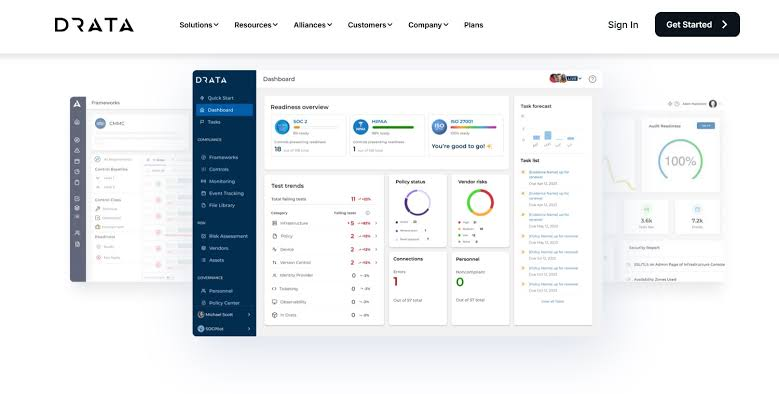
Drata is a compliance automation platform describing itself as an “agentic trust management platform”. It’s built around continuous compliance, internal and third-party risk, and real-time customer assurance. The products are Enterprise GRC, Compliance Automation, Trust Center, AI Questionnaire Assistance, Third-Party Risk Management, and Drata AI.
Its strength is the monitoring cadence. Controls are tested continuously against connected cloud systems, instead of checked at audit time, so you catch drift the week it happens. That works well when evidence lives in cloud infrastructure it can reach through an API. It thins out for controls that are physical, contractual, or on-premises.
Key Features
- Custom framework builder: Customizes compliance requirements beyond standard templates.
- Continuous evidence collection: Collects evidence across over 200 integrations.
- Automated compliance: Includes SOC 2, ISO 27001, HIPAA, and GDPR.
Best for
Cloud-native companies who want control drift caught continuously, and whose evidence mostly lives in systems with an API.
Pricing
Drata doesn’t publish figures or named tiers, which makes it the least transparent of the automation group. You’ll need to contact the platform’s sales experts for a per account quote.
Pros
- Continuous control testing against connected cloud systems surfaces drift within days
- Enterprise GRC, third-party risk, and Trust Center share one platform
- AI Questionnaire Assistance drafts security questionnaire answers from evidence already in the platform
Cons
- No native MyCSF integration
- Automation depth follows API coverage, so on-premises and contractual controls still need manual attestation
- No published framework count, only named examples
10. Secureframe
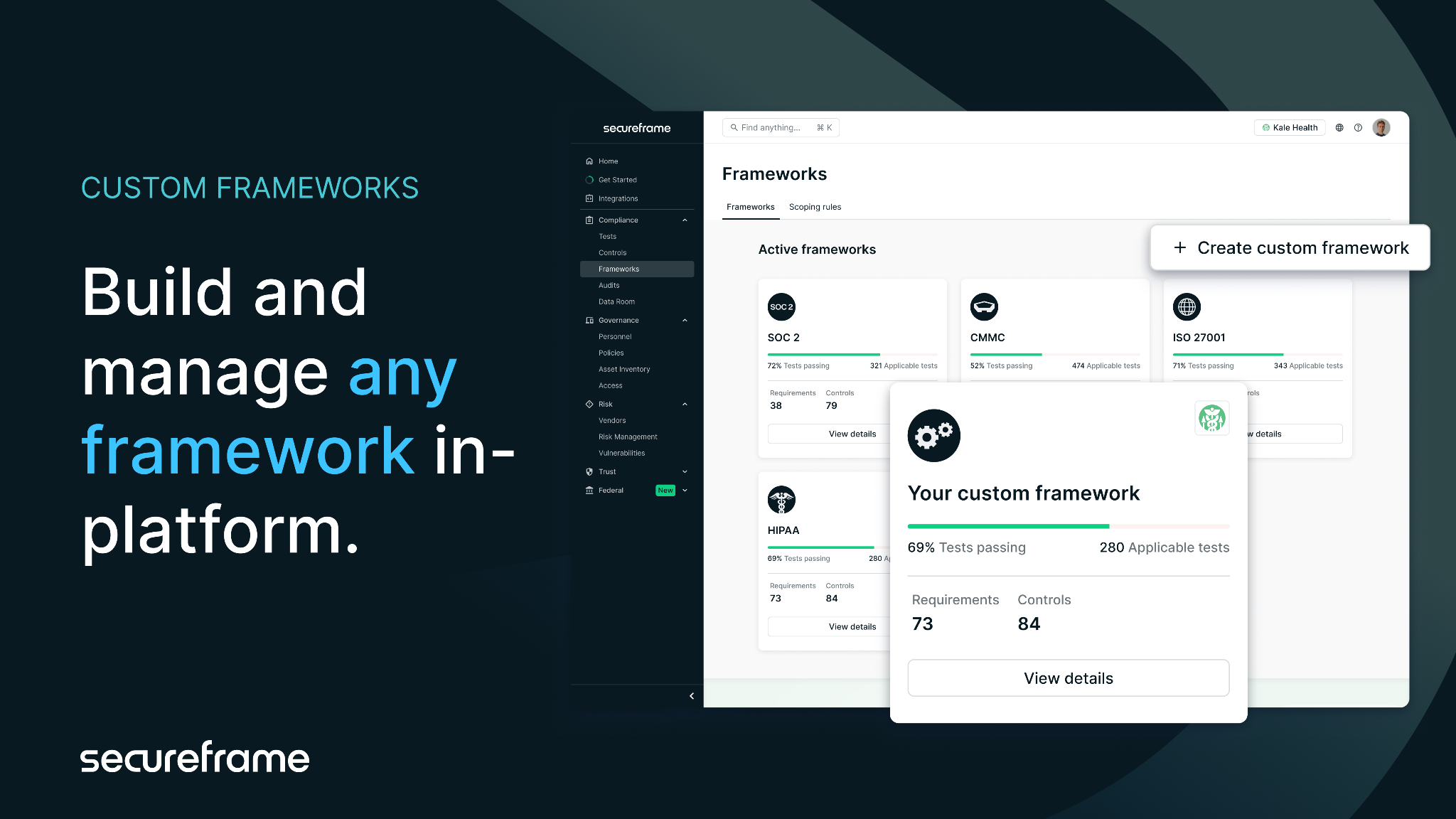
Secureframe is a compliance automation platform sold as three packages, which are Fundamentals, Complete and Defense. It publishes 300+ native integrations. Comply AI drafts policies and suggests remediation guidance, and the Secureframe Agent covers device and personnel monitoring.
Defense adds SPRS score tracking, System Security Plan and POA&M support, plus managed CUI enclaves and virtual desktops. That’s managed infrastructure for storing and protecting controlled unclassified information. Read the published feature matrix carefully though, because it lists “Compliance Framework: 1” for both Fundamentals and Complete.
Key Features
- Auto-Evidence Collection: Continuous monitoring across cloud infrastructure, HRIS, and developer tools.
- International Frameworks: Native support for GDPR, SOC 2, ISO 27001, HIPAA, PCI DSS, CMMC, and NIST.
- Policy Management: Pre-built security policies with version control and auditor-friendly formatting.
Best for
Defense contractors working toward CMMC, and lean teams who want a first framework automated with little setup.
Pricing
No public pricing, so it’s quoted per account. There are three named packages, which are Fundamentals, Complete and Defense. You will need the Complete tier at a minimum to run HITRUST alongside HIPAA and SOC 2.
Pros
- Defense includes managed CUI enclaves and virtual desktops
- 300+ native integrations
- SPRS score tracking and automated SSP statuses handle the artifacts CMMC assessors ask for
Cons
- Feature matrix lists just one compliance framework on Fundamentals and Complete, multi-framework programs cost extra
- Advanced third-party risk, advanced risk management and SSO only arrive at Complete
- Reporting and dashboard customization are less advanced than dedicated GRC platforms
Ready to see whether ZenGRC fits your program?
Your compliance program deserves more than a tool built for a single first audit. The right platform maps evidence once and reuses it everywhere, keeps HITRUST in step with the rest of your program, and gives you a flat number instead of a moving target.
ZenGRC delivers this with cross-framework control mapping, a native MyCSF integration for HITRUST, and flat-rate pricing that doesn’t change as you add frameworks. Every account comes with a named CSM, phone support and guided implementation, so most teams are live in weeks. Healthcare and financial services companies get the most out of the combined HIPAA, HITRUST and SOC 2 workflow.
Schedule a demo today to see how ZenGRC can help you achieve total compliance.
FAQs
1. Is Hyperproof still a good GRC platform?
Yes. It publishes 160+ supported frameworks, five products covering compliance, risk, audit, third-party risk and policy, plus a government edition for CMMC work. People move off it for fit, not quality. That’s usually when one framework needs more depth than a broad library gives, or when the pricing model stops matching how the team is growing.
2. Which Hyperproof alternative is best for HITRUST?
Check for a MyCSF integration rather than a HITRUST listing, because a listing doesn’t tell you where the assessment lives. ZenGRC connects to MyCSF through a native API, with evidence and control responses syncing both ways, and supports e1, i1, and r2 natively. HITRUST isn’t named on Optro’s or LogicGate’s own frameworks pages. Vanta does list it.
3. Do any GRC platforms publish their pricing?
None of the ten publishes dollar figures, so all ten are quoted per account. What differs is how much of the model they publish. LogicManager gives the most detail, with Job-to-be-Done pricing, unlimited users, advisory and onboarding included, and a 90-day money-back guarantee. Vanta and Secureframe publish named plans without figures. Drata, ServiceNow, and Archer publish neither.
4. How long does it take to move from one GRC platform to another?
It depends far more on the vendor’s model than on your data. LogicGate publishes implementation packages running about 30 to 150 days. ZenGRC says most teams are live in weeks, with guided implementation included. Ask any vendor for their published timeline, and treat “it depends” as an answer worth probing.
5. What happened to AuditBoard?
AuditBoard rebranded to Optro in March 2026, and auditboard.com now redirects to optro.ai. Same company, same products. You’ll still find the old name on support subdomains, developer docs and review-site listings, so expect to search both names while you compare.