
Rollout status and assessment cost estimates were rechecked on November 10, 2026.
Quick Summary
CMMC assesses how defense contractors protect Federal Contract Information (FCI) and Controlled Unclassified Information (CUI). Phase 2 remains suspended, while applicable self-assessments and safeguarding duties continue. Confirm your contract requirements, define scope, budget for implementation and assessments, and maintain evidence year-round. With ZenGRC, we help connect controls, evidence, and assessment work across your compliance program.
The Problem
A defense contract can leave your team facing unclear data boundaries, scattered evidence, and an uncertain assessment budget. Before assigning work, you need to know which requirements apply and how to prove your safeguards operate.
This guide explains Cybersecurity Maturity Model Certification (CMMC), its three levels, assessment costs, and the current rollout status. It also outlines how to prepare and maintain compliance throughout contract performance.
What Is CMMC?
Cybersecurity Maturity Model Certification (CMMC) is a Department of Defense program. It assesses whether defense contractors have implemented required cybersecurity measures. It covers contractors and subcontractors handling certain unclassified government information during covered defense work.
The program protects two types of information:
- Federal Contract Information (FCI): Nonpublic information provided by or generated for the government under a contract. It excludes publicly available information and simple transactional details, such as information needed to process payments.
- Controlled Unclassified Information (CUI): Information created or held by the government, or created or held on its behalf, that needs specific protections. Those protections must have a basis in applicable law, regulation, or government-wide policy.
Engineering drawings and technical reports can qualify as CUI. Their content and applicable safeguarding rules determine their status. The document type alone is insufficient.
The CMMC program rule connects assessment requirements to three security baselines.
- Level 1 uses FAR clause 52.204-21.
- Level 2 uses NIST SP 800-171 Revision 2.
- Level 3 adds selected NIST SP 800-172 requirements to the Level 2 baseline.
Contractors must implement the applicable safeguards and support their assessment findings with evidence. For example, an access policy describes how accounts should be managed. Account records and technical checks help show whether access actually follows that policy.
Preparation therefore involves security work, evidence collection, and coordination among control owners. Required affirmations attest to continuing compliance, while assessment evidence supports findings about implementation.
CMMC status applies to a defined assessment scope. Assessing one environment does not automatically establish compliance for unrelated systems elsewhere in the business.
Who Needs to Be CMMC Compliant?
CMMC applies to prime contractors and subcontractors processing, storing, or transmitting FCI or CUI during covered defense work. Subcontractors can fall within scope without holding a direct government contract.
Under 32 CFR 170.3, applicability generally covers acquisitions above the micro-purchase threshold, subject to phase-in rules and exceptions. The standard threshold became $15,000 on October 1, 2025. Special thresholds apply to certain purchases.
Review the solicitation, contract clauses, and information involved before deciding which requirements apply.
Prime Contractors and Subcontractors
CMMC requirements flow down when the subcontract itself requires processing, storing, or transmitting FCI or CUI. A CMMC clause in the prime contract alone does not trigger flow-down to unrelated subcontract work.
Under the subcontractor rules, covered FCI-only subcontractors require Level 1 (Self). For example, a logistics subcontractor handling only FCI does not automatically inherit its prime’s higher level.
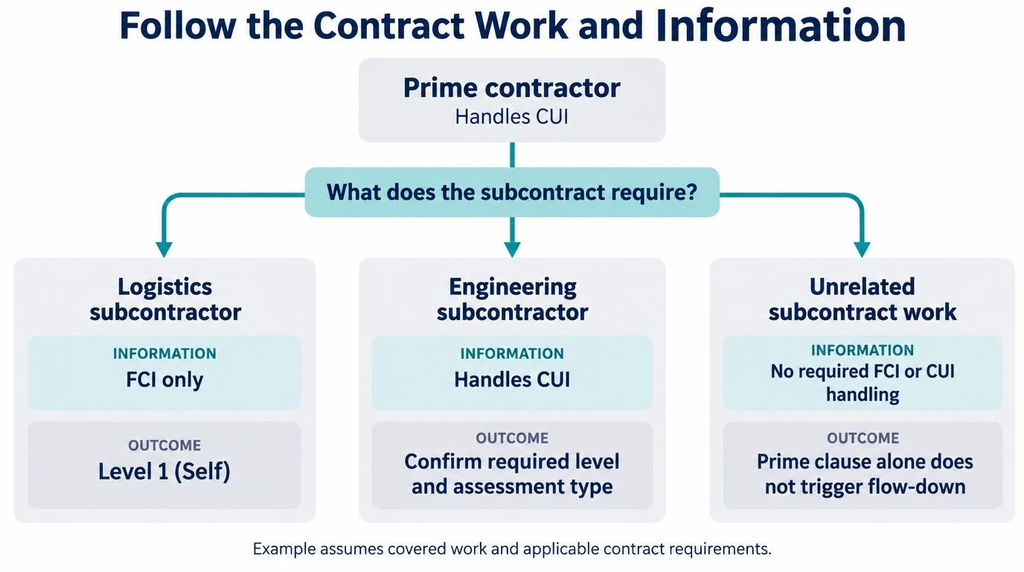
If that subcontractor begins handling CUI, review its required status and assessment scope before sharing the information. Primes must verify the appropriate current status before awarding covered subcontracts.
The COTS-Only Exemption
Contracts exclusively for commercially available off-the-shelf (COTS) items are excluded. Selling commercial products does not, by itself, establish this exemption.
Added services or government-specific modifications can change the analysis. Review the actual purchase and work requirements.
Service Providers and Shared Systems
External providers can affect assessment scope through their handling of CUI or operation of supporting security services.
Under DFARS 252.204-7012(b)(2)(ii)(D), contractors using external cloud providers for covered defense information must ensure FedRAMP Moderate-equivalent security. Providers must also meet paragraphs (c) through (g), covering incident reporting, malicious software, evidence preservation, and investigation support.
Check the specific service offering’s authorization or equivalency evidence and document shared responsibilities. Using a qualifying cloud service does not establish compliance for your entire environment.
The Three CMMC Levels Explained
CMMC defines three levels with different security requirements and assessment methods. The framework remains in place, while rollout policy determines which assessment requirements enter contracts.
Level 1: Foundational
Level 1 protects FCI through 15 safeguarding requirements in FAR 52.204-21. Examples include limiting system access, authenticating users, controlling physical access, and protecting systems from malicious code.
Organizations complete an annual self-assessment and enter results in the Supplier Performance Risk System (SPRS). An affirming official also confirms continuing compliance.
32 CFR 170.21(a)(1) prohibits plans of action and milestones (POA&Ms) at Level 1. Applicable requirements must be fully implemented to achieve Level 1 status.
Level 1 does not satisfy the requirements for handling CUI. Contractors taking on CUI work must review their required level and assessment scope.
Level 2: Advanced
Level 2 uses 110 security requirements from NIST SP 800-171 Revision 2. These address areas including access control, incident response, configuration management, and personnel security.
The framework provides self-assessment and third-party certification pathways. Authorized or accredited CMMC Third-Party Assessment Organizations (C3PAOs) conduct certification assessments.
Both pathways use a three-year assessment cycle, with annual affirmations.
Conditional Level 2 status requires a weighted assessment score of at least 88 out of 110. Under the scoring methodology, unmet requirements generally deduct one, three, or five points.
The score therefore does not simply count completed requirements. Unmet requirements must also satisfy POA&M eligibility restrictions. For example, the system security plan requirement cannot be deferred.
Permitted POA&M items require a closeout assessment within 180 days of the conditional status date. Final status requires the applicable security requirements to be met.
Level 3: Expert
Level 3 adds 24 selected NIST SP 800-172 requirements to the Level 2 baseline. These address advanced threats through measures including threat-informed risk assessments and stronger incident response capabilities.
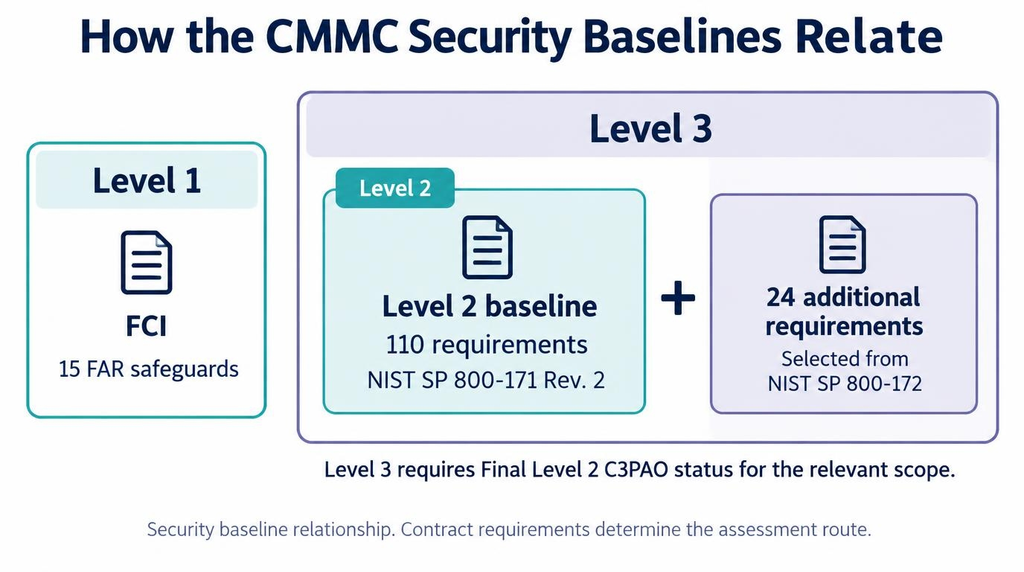
The Defense Contract Management Agency’s Defense Industrial Base Cybersecurity Assessment Center (DCMA DIBCAC) conducts Level 3 assessments. Final Level 2 C3PAO status is a prerequisite for the relevant assessment scope.
Level 3 requires reassessment every three years and annual affirmations. It remains defined in the CMMC program rule, despite the paused expansion of contractual assessment requirements.
CMMC vs NIST SP 800-171 vs DFARS: How They Fit Together
CMMC, NIST SP 800-171, and the Defense Federal Acquisition Regulation Supplement (DFARS) serve different, connected roles.
| Term | Main Role | What Your Team Does |
| NIST SP 800-171 | Defines security requirements for protecting CUI in nonfederal systems. | Implements and maintains applicable safeguards. |
| DFARS | Establishes defense acquisition requirements through solicitation provisions and contract clauses. | Checks award conditions, reporting duties, and subcontract obligations. |
| CMMC | Establishes assessment and affirmation requirements. | Demonstrates implementation and maintains the required status. |
Several DFARS provisions and clauses connect these responsibilities:
- 252.204-7012 requires safeguarding covered defense information and reporting covered cyber incidents.
- 252.204-7019 is a solicitation provision requiring a current NIST assessment for relevant covered systems before award. Offerors must verify that summary scores are posted in SPRS.
- 252.204-7020 requires access needed for government Medium or High assessments. It also requires contractors to check that covered subcontractors have completed current assessments before subcontract award.
- 252.204-7021 establishes duties to maintain CMMC status and continuing compliance.
- 252.204-7025 identifies the required CMMC level and assessment type in solicitations.
A NIST assessment score alone does not establish CMMC status. Check the CMMC Unique Identifier, level, assessment type, status date, and covered environment. Confirm that the required affirmation is current. Under 252.204-7025, current status and affirmation are separate award requirements.
Revision numbers also matter. NIST has published Revision 3, but the current CMMC Level 2 baseline remains Revision 2.
Keep your system security plan, evidence mapping, and assessment procedures aligned with that baseline. Track future revisions separately until an applicable requirement changes.
CMMC Timeline and Current Status in 2026
As of November 10, 2026, official guidance continues to show Phase 2 as suspended. The original November 10 start is not an active rollout deadline.
The Department of War (DoW) announced the suspension on July 13, 2026. Its official announcement confirms that Phase 1 self-assessment requirements remain in place.
The following milestones show how the assessment framework and contractual rollout developed:
| Date or Phase | What Happened | Planning Implication |
| December 16, 2024 | The CMMC program rule took effect. | The assessment framework became effective. |
| November 10, 2025 | Phase 1 began. | Applicable contracts began requiring Level 1 or Level 2 self-assessments. |
| July 13, 2026 | Phase 2 requirements were suspended. | The planned expansion of third-party assessment requirements was paused. |
| November 10, 2026 | Original Phase 2 start date. | This is no longer an active rollout deadline. |
| Phases 3 and 4 | Later implementation stages remain on hold. | Do not treat the original schedule as confirmed future deadlines. |
What Still Applies
Contractors must continue meeting applicable DFARS safeguarding obligations. The department’s current guidance identifies self-assessments and selected government-led assessments as continuing enforcement methods.
Keep required SPRS records and affirmations current. Maintain safeguards and evidence supporting assessment findings throughout contract performance.
The suspension also requires formal changes to affected solicitations and contracts. Implementation guidance directs officers to remove Level 2 C3PAO and Level 3 DIBCAC requirements:
- Active solicitations: Issue amendments as soon as practicable.
- Existing contracts: Remove the requirements through modification before the next option period or during the next scheduled administrative modification.
Ask the contracting officer for written clarification where existing language appears inconsistent with the suspension. Confirm the actual amendment or modification before changing your assessment plans.
What Could Change
The CMMC Reform Task Force summarized industry feedback in early September 2026. Federal News Network reported on that summary on October 27, after obtaining the document.
Reported options include restarting Phase 2 for a narrower population and extending the POA&M closeout window to 270 days. The report identifies the longer window as an option requiring rulemaking.
These are reported proposals, not active requirements or confirmed deadlines. The current POA&M rule retains the 180-day closeout period. Continue using that deadline unless an effective change applies to your organization.
Before publishing or bidding, recheck official announcements, applicable rules, and solicitation amendments. Assign an owner to track changes and update contract-specific assessment plans.
How CMMC Assessments Work
A CMMC assessment checks whether security requirements are implemented within a defined scope. Preparation starts by identifying the systems, people, facilities, and providers supporting the covered work.
For Level 2, the system security plan (SSP) describes the environment and how requirements are implemented. Network diagrams, asset records, and provider responsibility documents should match that description.
The Level 2 assessment guide breaks the 110 requirements into 320 assessment objectives drawn from NIST SP 800-171A. Evidence must support the applicable objectives. A policy document alone may not establish that a requirement is met.
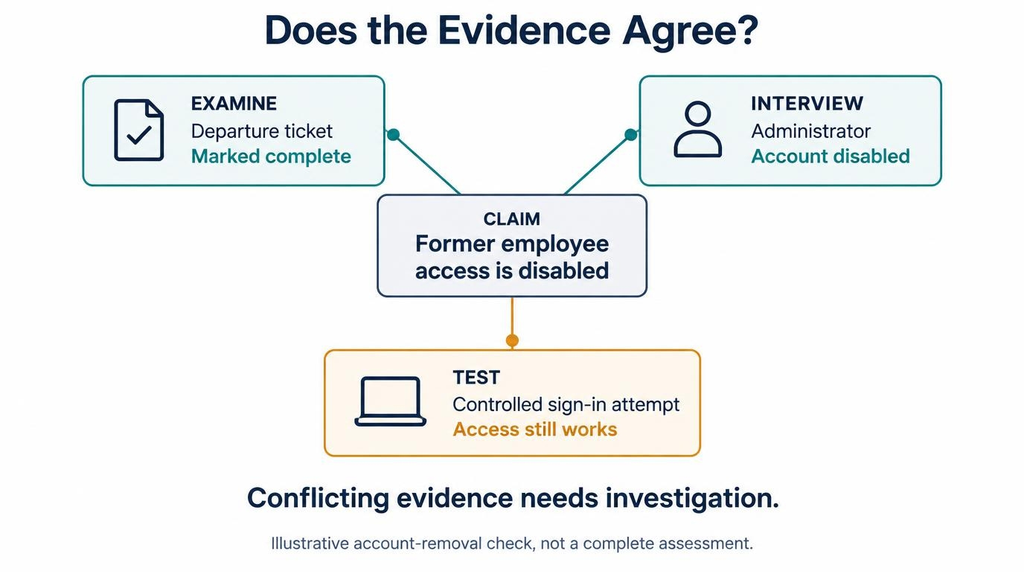
Assessment evidence is gathered through three methods:
- Examine: Review approved procedures, configuration records, access lists, and security logs.
- Interview: Ask responsible staff how they perform tasks and manage exceptions.
- Test: Exercise mechanisms or observe activities to check whether safeguards operate as intended.
For example, a reviewer assessing account removal might examine a departure ticket and interview the administrator. A controlled test could then confirm that the disabled account cannot authenticate.
For self-assessments, your organization conducts the review and records required results in SPRS. For Level 2 certification, a C3PAO conducts the assessment and submits results through CMMC eMASS. DCMA DIBCAC performs Level 3 assessments.
Where conditional status is permitted, a plan of action and milestones (POA&M) records eligible unfinished work and planned completion dates.
The POA&M rules restrict which requirements can remain open. Closeout must be confirmed through an assessment within 180 days of the conditional status date. Otherwise, conditional status expires.
Your organization performs Level 2 self-assessment closeout. A C3PAO performs Level 2 certification closeout, while DCMA DIBCAC handles Level 3.
Before submission, check that the scope, score, status date, and supporting records agree. Give the affirming official documented findings and any permitted unresolved items to support an informed affirmation.
How Much Does CMMC Compliance Cost?
An assessment quote covers only part of CMMC spending. Your team may also need security upgrades, remediation, staff time, and outside support.
The DoD’s October 2024 final rule publishes the following assessment-only estimates per entity. These are modeled costs, rather than current assessor quotes.
| Assessment and Period | Small Entity | Other Than Small Entity |
| Level 1 self-assessment, per year | $5,977 | $4,042 |
| Level 2 self-assessment, three years | $37,196 | $48,827 |
| Level 2 C3PAO certification, three years | $104,670 | $117,768 |
| Level 3 certification, three years | $12,802 | $44,445 |
Assessment-only: These figures cover preparation, assessment participation, reporting, affirmations, and modeled closeout work where applicable. They exclude security implementation and maintenance from this table. Some estimates already include outside assessment support, so avoid counting that work twice.
Level 1 and Level 2 estimates assume their underlying safeguards are implemented. The rule separately models Level 3 implementation and maintenance. Its Level 3 assessment figures also exclude the prerequisite Level 2 certification costs.
These figures are not full compliance budgets. Add tools, remediation, and implementation consulting where needed, using your actual scope and existing safeguards.
Build your budget around these categories:
| Cost Area | What to Include |
| Scope and readiness review | Data mapping, asset classification, control testing, and provider reviews. |
| Security improvements | Access controls, logging, encryption, secure configurations, and necessary system upgrades. |
| Documentation and evidence | SSP updates, procedure development, evidence collection, and staff preparation. |
| Assessment | Internal assessment labor or an applicable C3PAO engagement. |
| Ongoing maintenance | Monitoring, training, affirmations, reassessments, and permitted POA&M closeout. |
Request itemized proposals using the same assessment boundary and assumptions. Compare the sites, systems, providers, and shared services included in each proposal.
A quote for one isolated CUI environment covers different work from a proposal covering several connected sites. Evidence readiness can also affect the preparation work required.
Ask whether quotes include travel, readiness reviews, reporting, and closeout assessments. Track employee time separately from external fees, while checking for overlapping charges.
A smaller CUI environment may reduce work when separation is effective and documented. Supporting security systems and connected services still need correct classification.
During the Phase 2 pause, confirm whether third-party assessment spending supports a customer requirement or a voluntary business decision. Continue budgeting for applicable self-assessment and safeguarding duties.
Test existing controls before approving new purchases. If a safeguard works but lacks supporting records, focus spending on evidence and documentation.
CMMC Compliance Checklist: How to Prepare
Use this checklist to turn contract requirements into assigned work. Connect security improvements, documentation, and assessment preparation throughout the project.
- Confirm the contract requirement: Identify the required level, assessment type, applicable clauses, and award dates. Resolve unclear FCI or CUI designations with the customer before defining scope.
- Map the information flow: Trace protected information through users, devices, applications, backups, and providers. Include supporting security services. Use 32 CFR 170.19 to classify assets and document exclusions.
- Test existing safeguards: Compare actual settings and practices with applicable requirements. For Level 2, use Revision 2 and the matching DoD assessment guide. Record findings, owners, and evidence needs.
- Fix problems and update the SSP: Describe safeguards as they operate today. Keep planned improvements separate from completed work, and update diagrams and procedures when systems change.
- Organize supporting evidence: Map approved procedures, configuration records, training logs, and test results to requirements. Identify the relevant systems, dates, and owners so reviewers can check applicability.
- Confirm provider responsibilities: Document which controls your team operates and which providers support. Obtain supporting evidence and check cloud requirements against the specific service handling CUI.
- Review readiness and complete the assessment: Ask control owners to explain and demonstrate their work. Complete required reporting and the affirmation under 32 CFR 170.22.
Set preparation dates around contract requirements and planned assessments. If you achieve conditional status, calculate the closeout deadline from the Conditional CMMC Status Date. Under 32 CFR 170.21, permitted POA&M items require confirmed closeout within 180 days.
Work backward from that deadline, allowing time for fixes, retesting, the closeout assessment, and required reporting.
How to Stay CMMC Compliant Year-Round
Security controls can weaken between assessments through configuration changes, missed tasks, staff turnover, and provider updates. Assign owners to monitor safeguards and keep evidence current throughout contract performance.
Use a schedule that combines ongoing checks with reviews after changes:
- Ongoing: Monitor control operation and investigate failures. Set review frequencies according to applicable requirements, risk, and documented procedures.
- After relevant changes: Review access permissions, provider responsibilities, assessment scope, and the SSP. Check whether new tools receive protected information.
- Quarterly management checkpoints: Consider reviewing overdue actions, testing results, and evidence quality together. These checkpoints support oversight and do not replace more frequent operational checks.
- Before affirmation or reassessment: Confirm that records match the current environment. Give the affirming official supporting findings and details of unresolved issues.
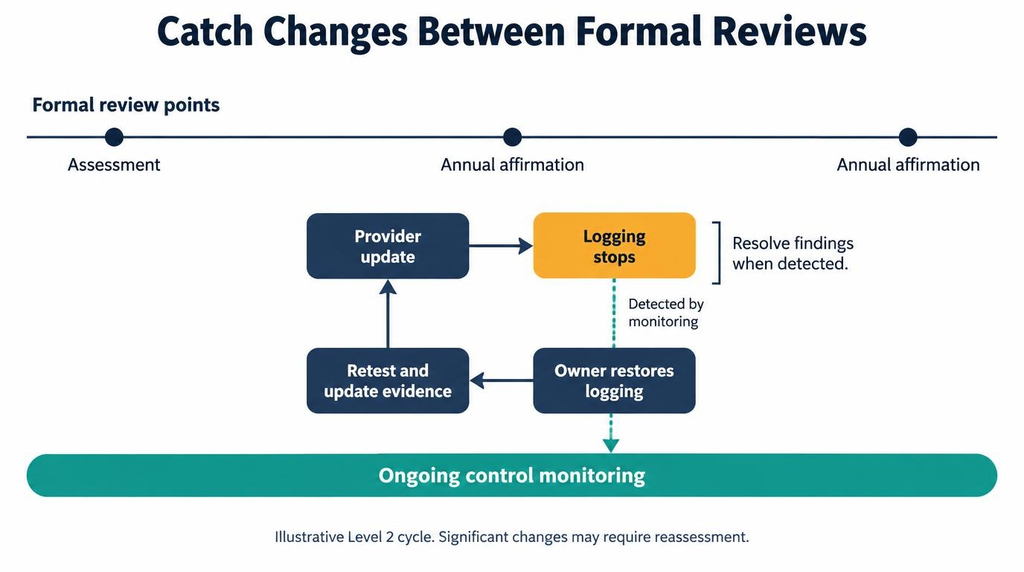
Under 32 CFR 170.22, affirmations are required after assessments, including POA&M closeout, and annually thereafter. The official attests that applicable safeguards are implemented and will remain implemented.
Level 1 requires annual self-assessment. Level 2 follows a three-year assessment cycle, with annual affirmations between assessments.
For conditional status, track permitted POA&M items against the 180-day closeout deadline. Escalate delays early enough to complete remediation, the closeout assessment, and required reporting.
Managing CMMC alongside other frameworks can leave teams collecting the same records more than once. Check whether existing evidence matches each requirement’s systems, reporting period, and detail before reusing it.
With our CMMC compliance software, we help map shared controls and connect supporting evidence across frameworks. Our more than 130 integrations help connect compliance work with the systems your teams already use.
Our AI assistant, supports program scoping and control design. Our AI control assessments also provide findings and explanations for your team to review. Your team approves the findings and remains responsible for implementing safeguards and maintaining the required status.
Book a Demo to see how we connect CMMC requirements, shared evidence, and assessment work.
Frequently Asked Questions (FAQs)
Do Joint Ventures Automatically Inherit a Parent Company’s CMMC Compliance Status?
No. Coverage depends on the systems supporting the venture’s contract, rather than ownership alone. Confirm that the assessed scope covers the work. With ZenGRC, we support partner due diligence through third-party risk assessments and questionnaires. These reviews cannot create or transfer CMMC status.
What Kinds of Changes Actually Trigger a New CMMC Assessment Versus an Annual Affirmation?
Adding Wi-Fi requires reassessment when wireless requirements were previously assessed as not applicable. Routine patching generally does not. With ZenGRC, our risk dashboards help leaders review identified risks when considering system changes. The affirming official remains responsible for deciding whether a change requires reassessment.
Does Encrypted CUI Count as In-Scope for CMMC Compliance, Even When It Leaves Your Network?
Encryption does not remove CUI status or automatically exclude storage systems. However, properly encrypted transit across a common carrier’s network does not bring that network into your assessment scope.
If Your Company Handles Only Paper-Based CUI, Do You Still Need a Third-Party CMMC Assessment?
Paper-only handling does not itself trigger a CMMC assessment of information systems. Safeguarding duties still apply. Scanning, photographing, or otherwise digitizing the information brings the relevant systems into consideration for applicable assessment requirements.
Which Level 2 Requirements Can Never Sit on a POA&M Under CMMC Compliance Rules?
The expressly excluded requirements are 3.1.20, 3.1.22, 3.12.4, 3.10.3, 3.10.4, and 3.10.5. Requirements worth more than one point are also excluded, with one limited exception: 3.13.11 when encryption exists but lacks FIPS validation.