
Founded in 2009, ZenGRC offers robust, intuitive products that help organizations graduate from manual processes and point solutions, turning compliance and risk management into a source of business advantage. We help organizations better navigate the complexities of governance, risk, and compliance.
What You Need To Know: Compliance Management Software
- Enterprise GRC platforms were built for Fortune 500 organizations with dedicated admins, large IT teams, and multi-year implementation budgets. Mid-market compliance teams pay for that complexity without getting value from it.
- Implementation timelines for enterprise platforms routinely run 6 to 12 months. Purpose-built compliance software for mid-market should be live in weeks.
- Cross-framework control mapping is the capability that matters most for growing compliance programs. Build a control once and it satisfies every framework it applies to, without duplicate evidence collection or redundant remediation work.
Most compliance teams don’t have a complexity problem. They have a fit problem.
When a Director of GRC at a 1,500-person company starts evaluating compliance management software, they often end up looking at platforms built for teams three times their size. The gap between what those platforms require to operate and what a mid-market team can actually sustain is where compliance programs stall.
Table of contents
- Compliance software built for a different buyer
- Where the overhead accumulates
- What mid-market compliance teams actually need
- The gap in the market is real
- The right question to ask
- Frequently Asked Questions
Compliance software built for a different buyer
Enterprise GRC platforms were designed for Fortune 500 security organizations with dedicated platform administrators, multi-year implementation budgets, and large IT teams to configure and maintain the system.
The mid-market reality looks different: 3 to 10 compliance professionals managing 3 or more frameworks, running lean, and responsible for audit readiness without a dedicated GRC admin on staff. Enterprise platforms assume a level of internal infrastructure that mid-market teams rarely have. Building that infrastructure just to run a GRC tool adds cost and time that the compliance program never recovers.

The pattern is consistent. Enterprise implementations run long. Configuration requires resources the team doesn’t have. Customization costs more than expected. Eighteen months after signing, the platform is partially deployed, the team is exhausted, and the compliance program has made little forward progress.
Where the overhead accumulates
The cost of a poor platform fit shows up in three places.
Implementation time is the most visible. Enterprise GRC implementations routinely run 6 to 12 months. For a compliance team with an audit in 90 days, that timeline doesn’t work. For a team trying to expand from SOC 2 to ISO 27001 before a customer contract closes, it is a deal-breaker.
Total cost of ownership compounds the problem. The license fee is only the beginning. Professional services for implementation, dedicated configuration work, and ongoing admin resources to keep the system current add up quickly. Mid-market budgets don’t absorb those line items cleanly, and teams that didn’t budget for them often find themselves locked into a platform they can’t fully use and can’t afford to leave.
Administrative burden is the quieter cost. Mid-market teams need the GRC tool to support the compliance program, with the same people doing both jobs. A platform that requires specialist resources to change a workflow or add a custom field creates a dependency the team can’t sustain.
What mid-market compliance teams actually need
The requirements look different when your team is 5 people managing 4 frameworks against a fiscal year audit schedule. Here is what good compliance management software actually does for that team.
Cross-framework control mapping
Mid-market teams rarely manage just one framework. SOC 2, ISO 27001, HIPAA, NIST, PCI DSS – often several at once. The controls across those frameworks overlap significantly. A control for access management often satisfies the same requirement across multiple frameworks simultaneously. Good compliance software maps those relationships automatically. Build the control once, and it applies across every framework it satisfies. The evidence counts everywhere it should.

Teams that manage frameworks in isolation rebuild the same control structure every time they add a new one. They collect the same evidence multiple times and run separate remediation cycles for overlapping gaps. Cross-framework mapping removes that duplication. For a 5-person team, that is the difference between managing compliance and being buried by it.
Automated evidence collection
Collecting evidence manually is where compliance programs lose the most time. Someone emails a stakeholder asking for a screenshot. Two weeks pass. The deadline moves. The auditor asks for something more current. The process starts again.
Good compliance management software connects directly to the systems where evidence lives, cloud infrastructure, identity providers, vulnerability management tools, ticketing systems, document repositories. Evidence pulls on a schedule, maps to controls automatically, and stays current between audit cycles. A team that previously spent three weeks in audit prep can cut that to days because the evidence is already there, already mapped, and already current.
Self-service configuration
A compliance program changes constantly. New frameworks get added. New controls get scoped. New stakeholders need to be assigned. Good compliance software lets the compliance team own all of that directly, without opening a support ticket or requesting developer time. Workflows, assessments, custom controls, notification rules – these should be configurable by the people running the program.
Risk tied to compliance
Risk management and compliance audit management share controls, share evidence, and share the same stakeholders. Good mid-market compliance software connects the risk register directly to compliance activities and findings. When a control fails, the corresponding risk record updates. When a new vendor introduces risk, it connects to the frameworks that govern it. Keeping these as separate modules or separate tools creates blind spots that surface in audits and board reviews.
Audit management that works for small teams
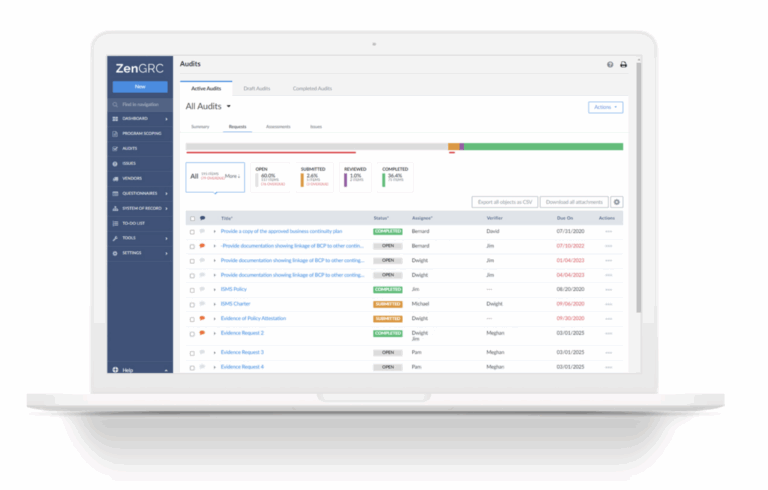
Mid-market compliance teams manage the evidence request list, coordinate with external auditors, track open items, and close findings, all while keeping the rest of the compliance program running. Good compliance software handles the full audit lifecycle without requiring a dedicated audit manager to operate it. Document request lists get parsed automatically. Evidence assignments go to the right people. Findings track through remediation without the compliance team manually orchestrating the process.
Reporting the team can actually use
The board asks for a risk posture update. The CISO needs a framework readiness snapshot before an executive meeting. The compliance manager needs to show which controls are failing and why. Good compliance software produces those outputs from the data already in the system, in real time, without requiring a separate analyst to build them.
The gap in the market is real
The GRC software market has a documented gap between startup tools built for a first SOC 2 and enterprise platforms built for organizations with dedicated GRC teams and seven-figure implementation budgets. Teams in the middle, managing three or more frameworks, growing past 500 employees, running a compliance program with a small team carrying significant responsibility, are the underserved segment.
Purpose-built compliance management software for mid-market fills that gap. A system a 5-person team can own, configure, and expand without consultants, without a dedicated admin, and without a 12-month runway before the program starts generating value.
The right question to ask
When evaluating compliance management software, mid-market teams should ask one question before anything else: was this platform built for my team, or was it built for a buyer with 10 times our headcount and 10 times our budget?
The answer shapes the implementation timeline, the total cost, and whether the compliance program runs the way it was designed to.
Talk to an expert on our team to get the answers you need for your compliance program.
Frequently Asked Questions
Compliance management software focuses on the day-to-day work of running a compliance program, framework management, evidence collection, control tracking, audit readiness, and risk documentation. GRC platforms are broader by design, built to cover governance, risk, and compliance across an entire enterprise, often including modules for legal, audit, ESG, privacy, and more. For mid-market teams with a defined compliance scope, the breadth of an enterprise GRC platform adds overhead without adding value. Purpose-built compliance software covers the full program without requiring a team to maintain capabilities they don’t use.
Good mid-market compliance software supports the frameworks mid-market teams actually manage. For most teams, that includes SOC 2, ISO 27001, HIPAA, NIST CSF, NIST 800-53, PCI DSS, HITRUST, CMMC, FedRAMP, and others. More important than the count is how frameworks connect. A platform that supports 35 frameworks but requires teams to manage each one separately still creates duplicate work. Cross-framework control mapping, the ability to map a control once and have it satisfy requirements across multiple frameworks simultaneously, is what actually reduces workload as the program grows.
Implementation timelines vary significantly by platform and team size. Enterprise GRC platforms typically run 6 to 12 months, requiring dedicated project teams and professional services engagements. Purpose-built mid-market compliance software should be live in weeks, with a working compliance program, connected integrations, and mapped frameworks, before a 90-day audit window closes. When evaluating a platform, ask specifically what week one looks like and what the team will need to provide internally to hit that timeline.
Compliance software pricing varies widely. Some platforms charge per user, per framework, or per module, which makes total cost difficult to predict as programs grow. Before signing, ask what the total cost looks like at year one, year two, and year three. Ask whether adding a new framework, a new user, or a new integration triggers an additional charge. Ask what professional services are required, whether they are included, and what happens if implementation takes longer than expected. Flat, predictable pricing matters more than a low initial number when the program is expected to expand.
The integrations that matter most are the ones that connect to where your evidence actually lives. That typically includes cloud infrastructure providers like AWS, Azure, and GCP, identity and access management tools like Okta and Azure AD, ticketing and workflow systems like Jira and ServiceNow, vulnerability management platforms, and document repositories like SharePoint, Confluence, and Google Drive. The integration count is less important than how those integrations work. Automated, scheduled evidence pulls that map directly to controls are what reduce manual work. One-way data pulls that still require a team member to review, sort, and upload evidence manually don’t solve the problem.
The most common signals are operational. Audit prep still feels like a fire drill even though the tool is running. Adding a new framework means rebuilding work that already exists in the platform. Evidence collection still depends heavily on email and manual follow-up. Reports require significant manual effort to produce before a board or leadership meeting. If the team is doing more work to maintain the tool than the tool is saving them, that is a fit problem worth addressing before the next audit cycle.