
Founded in 2009, ZenGRC offers robust, intuitive products that help organizations graduate from manual processes and point solutions, turning compliance and risk management into a source of business advantage. We help organizations better navigate the complexities of governance, risk, and compliance.
What You Need To Know: Healthcare Compliance Program
- A healthcare compliance program manages HIPAA, HITRUST, and related frameworks as one unified program, not separate workstreams.
- Most programs break at the spreadsheet ceiling, the single-framework trap, or a 6-to-12-month implementation that delays the next audit cycle.
- The right platform handles both HIPAA and HITRUST in one place, automates evidence collection, and goes live in weeks.
A healthcare compliance program is not a checklist. It is an ongoing operational commitment. And for most security and compliance leaders managing 3, 4, or 5 frameworks with a lean team, it is one of the most demanding things their organization runs.
This guide covers what a healthcare compliance program requires, where most teams get stuck, and what to look for when evaluating platforms to manage it.
For a deeper look at why compliance is business-critical in healthcare, see Importance of Compliance in Healthcare.
Table of contents:
- The compliance problem in healthcare is a people problem
- What a healthcare compliance program does
- Where most healthcare compliance programs break
- HIPAA compliance: what your program needs to cover
- HITRUST compliance: what your program needs to cover
- How to evaluate platforms for your healthcare compliance program
- What the right platform looks like
- See how ZenGRC supports your healthcare compliance program
The compliance problem in healthcare is a people problem
Healthcare organizations run two compliance programs. They just rarely treat them that way.
HIPAA sits with legal and privacy. It is required by law, managed in documents and spreadsheets, and audited infrequently. HITRUST sits with security and InfoSec. It is technical, system-driven, and tied to a two-year certification cycle.
The controls overlap significantly. HITRUST r2 covers 100% of the HIPAA Security Rule. Access controls, encryption, audit logging, incident response, risk assessment, workforce training, and backup and recovery all appear in both frameworks.
But most organizations collect evidence for each framework separately. Two teams, two tools, two sets of documentation. The same work repeated because the systems do not talk to each other.
This is the two-worlds problem. A well-built healthcare compliance program is designed to solve this problem.
What a healthcare compliance program does
A healthcare compliance program gives security and compliance teams a single structure to manage frameworks, track controls, collect evidence, run audits, and report program health to leadership. For most healthcare organizations, that means running HIPAA and HITRUST in parallel, alongside SOC 2, ISO 27001, or NIST depending on customer and regulatory requirements.
The core functions are cross-framework control mapping, automated evidence collection, audit lifecycle management, and real-time program reporting.
For a full breakdown of how these work together in practice, see Managing Compliance in Healthcare.
For healthcare specifically, a purpose-built program handles:
Cross-framework control mapping
HIPAA, HITRUST, SOC 2, ISO 27001, NIST, PCI DSS. Healthcare organizations managing multiple frameworks spend significant time testing the same controls multiple times, collecting the same evidence for different audits, and running the same assessments across overlapping frameworks.
Cross-framework control mapping fixes this: map a control once and the platform applies it to every framework that requires it. Your team tests once and the evidence satisfies many. Making your life easier, and giving you back time to focus on more important matters.
Audit management
Healthcare organizations are effectively always in audit mode. HITRUST r2 runs on a two-year cycle with interim assessments. HIPAA is annual. SOC 2 is annual. The teams that handle this well are not working harder. They have a system. Evidence is collected continuously, not in a sprint before each cycle.
Evidence collection and automation
Manual evidence collection is the most time-consuming part of any healthcare compliance program. Teams pull screenshots, export reports, chase down system owners, and organize files for each audit cycle.
With 117 pre-built integrations across security, identity, and cloud systems, the right platform automates evidence collection continuously. Evidence is always current. The team is always audit-ready.
For a detailed look at automating evidence collection, see What Is Automated Evidence Collection (And Why Your Audit Prep Is Still Painful Without It)
Risk management
Healthcare organizations face risk from multiple directions: internal systems, third-party vendors, workforce practices, and technology infrastructure. A mature compliance program connects the risk register to the control framework. Risks map to controls. Controls link to evidence. The program has a single source of truth.
HITRUST MyCSF integration
For organizations managing HITRUST, integration with HITRUST’s MyCSF platform eliminates the duplicate work between the assessment environment and the compliance program. Control updates from HITRUST flow directly into the platform. Evidence workflows are built around the assessment cycle and the time to certification shortens.
Where most healthcare compliance programs break
Healthcare compliance programs fail in predictable ways. They do not fail all at once. They slowly become unmanageable.
The spreadsheet ceiling
Spreadsheets work (until they don’t). A compliance program managed in spreadsheets is built around one person’s knowledge. When that person leaves, the knowledge goes with them. When the audit cycle accelerates, the spreadsheet cannot keep up. When leadership asks for a program health update, there is no real-time answer.

The single-framework trap
Many healthcare organizations start with one framework, usually SOC 2 or HIPAA, and add frameworks as the business grows. Tools built for a single framework do not scale. Adding a second framework means building a second process. Adding a third means three separate processes running in parallel.
The GRC implementation that never ends
Enterprise GRC platforms built for large organizations take 6 to 12 months to implement. Healthcare compliance teams do not have 6 to 12 months. They have an audit coming up. They need to be ready. A platform that takes a year to configure is not a solution.
The two-team problem
When HIPAA and HITRUST are managed by different teams with different tools, nobody has a unified view of the compliance program. Gaps are invisible until an auditor finds them. Duplicate work is invisible until someone does the math.
HIPAA compliance: what your program needs to cover
HIPAA governs how protected health information is stored, transmitted, and disclosed. For security and compliance leaders, the Security Rule is the operational focus: documented controls across access management, encryption, audit controls, transmission security, and risk analysis.
HITRUST compliance: what your program needs to cover
HITRUST is more technically demanding than most compliance frameworks. The r2 assessment covers approximately 1,900 controls across 14 control categories. The e1 covers 44. The i1 covers 182. Certification runs on a two-year cycle and does not stop.
How to evaluate platforms for your healthcare compliance program
Most GRC platforms claim to support healthcare frameworks. Fewer are built for healthcare compliance teams. Here is how to tell the difference.

Ask about implementation time
A platform that takes 6 months to implement is not built for compliance teams that need to move. Ask specifically: how long until a team is running their first HIPAA audit in your platform? The answer should be weeks, not months.
Ask about cross-framework mapping
If a vendor cannot show you how a single access control maps across HIPAA, HITRUST, and SOC 2 in the same interface, they do not have real cross-framework mapping. They have multiple frameworks in the same tool. That is different.
Ask about evidence reuse
The same evidence that satisfies HIPAA access control requirements also satisfies HITRUST and SOC 2. Ask the vendor to demonstrate how evidence collected for one framework is reused for another. If they cannot, your team will collect the same evidence multiple times.
Ask about data security
Healthcare compliance teams manage sensitive program data. Ask whether the platform is single-tenant or multi-tenant. In a single-tenant architecture, your data is in its own isolated environment. It does not share infrastructure with other organizations. For teams managing PHI program data, this is not optional.
Ask about the support model
A healthcare compliance program is not a self-service problem. Ask whether you get a dedicated customer success manager, not a shared queue. Ask whether implementation support is included. Ask whether you can call someone when an auditor asks for something unusual.
What the right platform looks like
The right platform for a healthcare compliance program does three things well.
- It handles both HIPAA and HITRUST in one place, with controls mapped across both frameworks so your teams are not running two separate programs.
- It automates the evidence collection that currently consumes your team’s time, connecting directly to the systems that store and transmit PHI.
- It is live and running within weeks, not after a months-long implementation that delays your next audit cycle.
Healthcare compliance programs are not getting simpler. The frameworks are expanding. The auditors are getting more specific. The teams managing these programs need tools built for the actual work, not enterprise platforms scaled down or startup tools scaled up.
See how ZenGRC supports your healthcare compliance program
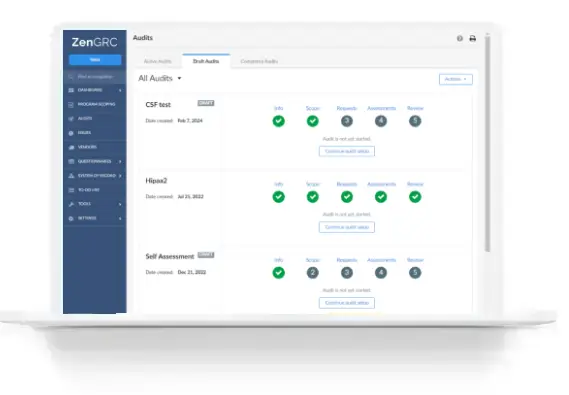
ZenGRC maps HIPAA and HITRUST controls in one platform. It connects to 117 integrations for automated evidence collection. It includes direct HITRUST MyCSF integration. And it runs on a single-tenant architecture so your program data stays yours.
Request a demo to see HIPAA and HITRUST management in the same platform.