
Vanta vs Drata Comparison: Features, Pricing, and Why Mid-Market Teams Choose ZenGRC
Quick summary
Most teams narrow their first SOC 2 decision down to Vanta vs Drata. Vanta wins on integrations. Drata wins on user experience. But both hit a ceiling when a second framework enters the picture. For mid-market teams running SOC 2, HIPAA, and HITRUST simultaneously, ZenGRC is the more capable fit.
Vanta vs Drata: Why do teams look for an alternative?
Two tools dominate the SOC 2 conversation for growing companies: Vanta and Drata. Both have earned that reputation. They defined the SOC 2 automation category. And for a first certification, either is a legitimate choice.
This Vanta vs Drata comparison takes a more critical look at both. We examine each tool’s integration depth, user experience, pricing, and compliance framework coverage. We surface where each wins, where both fall short, and why mid-market teams managing multiple frameworks move to ZenGRC.
Vanta vs Drata: How they compare
Here’s how Vanta and Drata stack up against each other:
1. Integration library and automation depth
Vanta leads on raw integration count. It offers a broad integration library, including AWS, GCP, GitHub, Okta, and more. Drata covers the major platforms well, but Vanta’s library remains broader.
Where they differ more meaningfully is automation reliability. Drata’s automation is consistently described as more reliable. It continuously collects evidence in the background, keeping controls accurate without teams having to chase anything down.

2. Framework coverage
Both tools support SOC 2, HIPAA, ISO 27001, GDPR, and PCI. Both are strong across those frameworks. Beyond those though, coverage depth thins out for both. HITRUST is where the gap shows up most clearly.

3. User experience and reporting
Drata gets consistent praise for a cleaner interface and more polished audit-ready reporting. Control owners find it easier to navigate, and auditors find the evidence presentation well-organized.
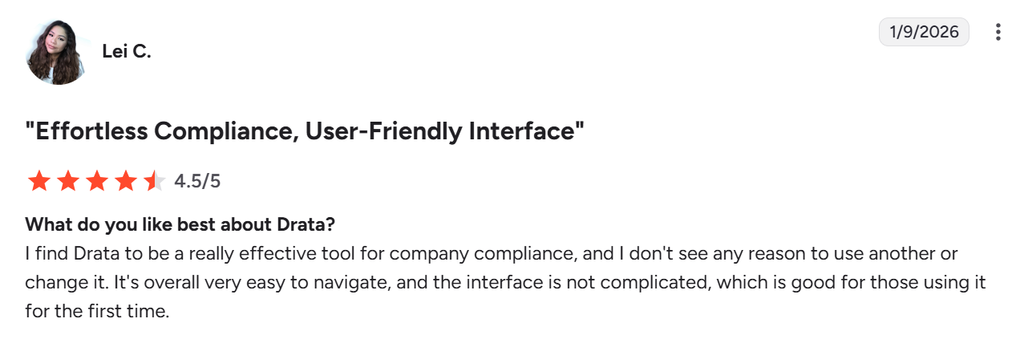
Vanta’s UI is functional but less refined. For teams that value depth and integration coverage over day-to-day polish, that trade-off makes sense.

4. Pricing
Neither company publishes pricing on their website. Vanta has four tiers: Essentials, Plus, Professional, and Enterprise. Based on procurement disclosures, Vanta starts at around $7,500 to $15,000 annually. Drata is in the same range for a startup SOC 2 plan. Both scale up as you add frameworks, users, and vendors. And both tend to apply annual price increases on renewal.
5. Customer support and implementation
Drata’s support has taken hits in user reviews. As the company has scaled, response times and quality have become less consistent. Vanta maintains a stronger support reputation.

Why Drata and Vanta fall short for GRC?
Here is where it shows up:
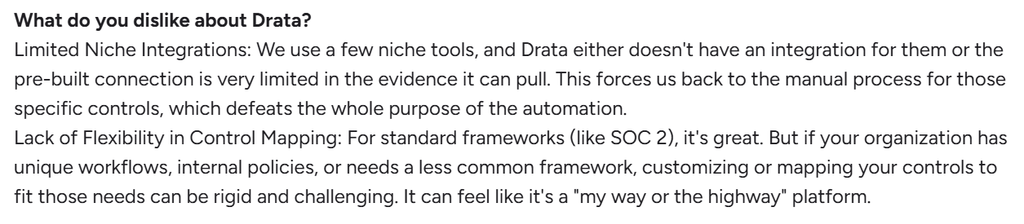
1. The multi-framework wall
SOC 2 alone is manageable in both tools, and both offer some level of control mapping across frameworks.
But as your compliance needs grow more complex, that mapping does not eliminate the operational burden. For a three-person compliance team already stretched thin, that adds up fast.
2. Automation breaks at scale
Both tools automate evidence collection by pulling data from your connected systems. For a lean SaaS stack, that works well.

As teams scale and infrastructure gets more complex, however, reliability starts to slip. Automated evidence collection becomes less reliable. And gaps surface at the worst time: audit.
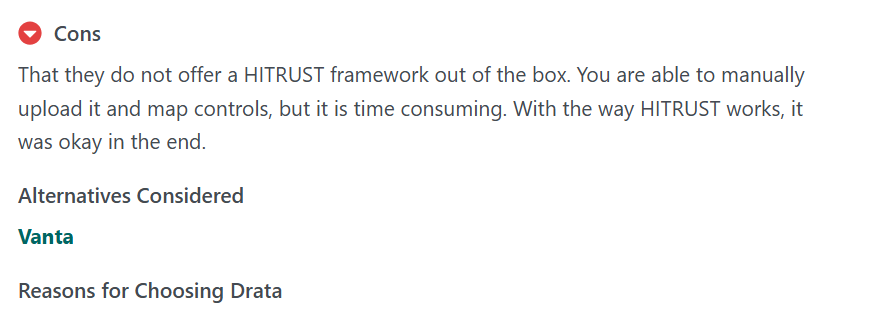
3. Limited HITRUST depth
Any team adding HITRUST to their compliance program will feel this one. Vanta does have a MyCSF integration that syncs controls and evidence. It can export auditor-approved evidence back into MyCSF. But it is still not the same as a platform built around the full HITRUST workflow.
Drata supports HITRUST as well. But third-party reviews still describe its HITRUST handling as more manual and less native than Vanta’s.
Related: check our list of the best HITRUST compliance tools.
4. High renewal costs
Pricing at renewal is a real ceiling. Both tools are easy to justify in year one. But once more frameworks, modules, and complex requirements are added, the price jumps materially.

What growing teams need to look out for
Teams that outgrow Vanta and Drata want something that handles their current requirements without increased complexity. Here is what they look out for during evaluation. They look out for:
- Native multi-framework support across SOC 2, HIPAA, HITRUST, and PCI
- Native HITRUST program management beyond syncing
- Pricing that does not punish further growth
- An implementation timeline measured in weeks, not months
- Dedicated support from people who know the work
ZenGRC: A better mid-market alternative

At a certain point, Vanta and Drata stop being enough. Teams managing multiple frameworks need a platform with more depth, but without the overhead of a full enterprise deployment.
ZenGRC is built for exactly that stage. It is a unified, full-featured GRC that offers more framework coverage than Vanta and Drata – making it an ideal alternative.
Here’s why mid-market teams make the switch:
- Multi-framework support: Vanta and Drata are built around a single framework. ZenGRC is built for mid-market teams handling multiple compliance frameworks, with native support across SOC 2, HIPAA, HITRUST, and PCI.
- AI-powered automation: ZenGRC uses agentic AI to automate analyst-level work such as program scoping, control design, and audit structure generation. This helps lean teams manage complex compliance programs more efficiently.
- Full bidirectional MyCSF sync: As an official HITRUST MyCSF integration partner, ZenGRC allows bidirectional evidence and control syncing. One evidence set can simultaneously satisfy SOC 2, HIPAA, and HITRUST requirements.
- Enterprise-grade data security: ZenGRC creates a new isolated AI model for each use and destroys it immediately after completion. Data is never shared externally or used to train models. So the integrity of your compliance data is never compromised.
- Auditor portal with controlled access: A dedicated auditor portal with controlled access gives external auditors what they need, without exposing sensitive information. Automated PBC collection also reduces the back-and-forth that slows audit cycles down.
- Predictable pricing and deployment: ZenGRC runs on flat, unlimited pricing that does not change as frameworks or users are added. And implementation takes weeks, not the six to twelve months typical of enterprise tools. So mid-market teams get the depth they need on a timeline that works.
Feature comparison: Vanta vs Drata vs ZenGRC
Here is a comparison of all three tools side by side:
| # | Criteria | Vanta | Drata | ZenGRC |
|---|---|---|---|---|
| 1 | SOC 2 | Native. | Native. | Native. |
| 2 | HIPAA depth | Strong. | Strong. | Strong. |
| 3 | HITRUST depth | Partial. | Partial. | Native HITRUST workflows and assessments. |
| 4 | MyCSF integration | Yes, control and evidence sync. | No native integration. | Full program management with framework flexibility. |
| 5 | Multi-framework control mapping | Partial. | Partial. | Native cross-mapping across SOC 2, HIPAA, HITRUST, NIST, PCI, ISO, CCPA, COBIT, and more. |
| 6 | Pricing model | Per user, per framework, per vendor. | Scales with complexity. | Predictable all-inclusive pricing with no hidden modules. |
| 7 | Implementation timeline | Several weeks to onboard. | Several weeks to onboard. | 4 to 6 weeks with onboarding included in contract. |
| 8 | Support model | Live chat during work hours. | Tiered support, CSM at higher plans. | Named CSM and phone support. |
| 9 | Best for | Teams managing their first SOC 2. | Startups pursuing first SOC 2. | Mid-market and enterprise teams managing multiple frameworks. |
Making the call: Vanta, Drata, or ZenGRC
Choosing between Vanta vs Drata depends on what you need. If you’re managing your first SOC 2 and want a broad integration library, Vanta is ideal. Drata, on the other hand, is your bet for a cleaner reporting experience at the same stage.
However, for mid-market organizations managing multiple frameworks, ZenGRC is the strongest fit. Its unified platform is built to scale with your compliance program.
Book a demo to see how ZenGRC works today.
Frequently Asked Questions
1. When should you switch from Vanta or Drata to another GRC tool?
Most teams feel the ceiling when a second framework arrives or a payer requires HITRUST r2. Cross-framework control mapping turns manual, audit prep takes longer, and per-user pricing scales in a way that no longer makes sense.
2. What is the best Vanta or Drata alternative for mid-market teams?
ZenGRC. Vanta and Drata were built for startups running their first SOC 2. But once your compliance program grows, ZenGRC is the best fit.
The platform maps controls across multiple frameworks. One piece of evidence can satisfy SOC 2, HIPAA, and HITRUST at the same time. It also includes agentic AI, customizable dashboards, and implementation completed in just 2 to 3 weeks with onboarding support included in the contract.
3. How much do Vanta and Drata cost compared to ZenGRC?
Vanta and Drata typically start between $7,500 and $15,000 annually for early-stage SOC 2 programs. But costs can exceed $100,000 annually as organizations add more frameworks and users.
ZenGRC uses a flat, unlimited pricing model instead. One price covers all users, all supported frameworks, AI-powered capabilities, and implementation support. This makes costs more predictable for mid-market organizations.
3. Does Vanta or Drata work for healthcare companies?
Both work for healthcare companies at the SOC 2 and HIPAA stage. However, neither tool was built for the full HIPAA plus HITRUST plus SOC 2 program. ZenGRC supports native HITRUST workflows and cross-framework mapping, making it a stronger fit for more mature healthcare compliance programs.
5. Can Vanta or Drata handle HITRUST certification?
Both support HITRUST-related workflows, but not natively. Evidence collection, control tailoring, and assessor collaboration still require some manual work.